
Key Highlights
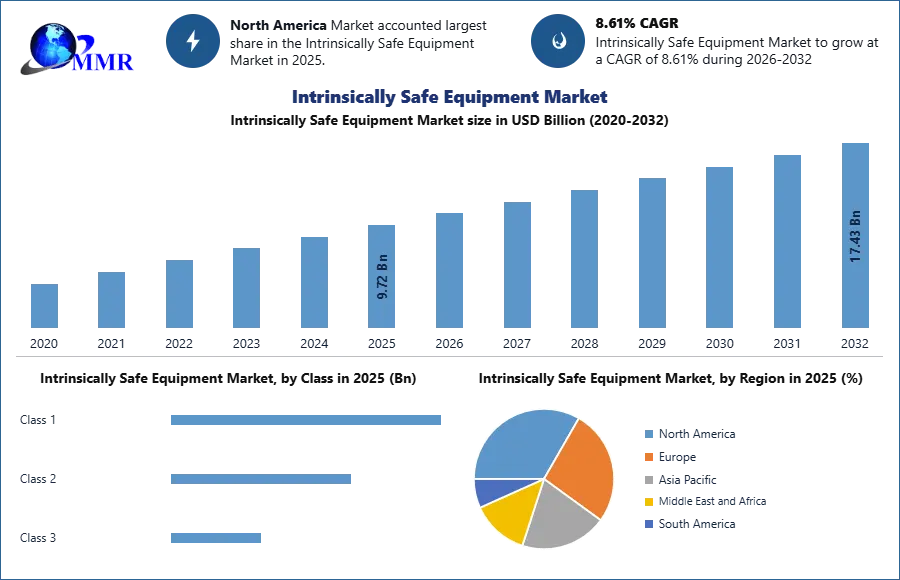
- Intrinsically Safe Equipment Market reached USD 9.72 billion in 2025.
- Market expected to grow at 8.61% CAGR through 2032.
- Forecast value projected at USD 17.43 billion by 2032.
- Industrial IoT deployment is creating new demand for intrinsically safe monitoring systems.
- Oil & gas, mining, chemicals, and manufacturing remain core adoption sectors.
- Wireless and IoT-enabled devices are becoming strategic growth drivers.
- Regulatory compliance continues to shape purchasing decisions globally.
- Emerging opportunities are appearing in renewable energy and smart manufacturing environments.
Why This Matters Now
Industrial operations are becoming more connected, automated, and data-driven. Yet many of the world’s highest-value facilities still operate in environments where a single spark can trigger catastrophic consequences.
That contradiction is reshaping investment priorities. As factories deploy industrial IoT networks, predictive maintenance platforms, wireless sensors, and real-time monitoring systems, demand is rising for equipment capable of delivering digital intelligence without creating ignition risks. The Intrinsically Safe Equipment Market sits directly at that intersection of safety, automation, and industrial transformation. The market’s projected expansion from USD 9.72 billion in 2025 to USD 17.43 billion by 2032 signals that safety technology is increasingly becoming a strategic infrastructure investment rather than a regulatory obligation.
Market Overview
Intrinsically Safe Equipment Market is engineered to prevent electrical or thermal energy from reaching levels capable of igniting explosive atmospheres. Its role has expanded far beyond traditional compliance requirements.
Industries including oil & gas, mining, chemicals, manufacturing, and process industries are integrating these technologies into broader digital transformation initiatives. The market’s forecast CAGR of 8.61% reflects a structural shift in how industrial operators view operational risk, workforce safety, and production continuity. Every percentage point of growth represents greater deployment of connected safety infrastructure across hazardous industrial environments.
What changed is the convergence of industrial automation and workplace safety. Previously, companies viewed safety systems and operational technologies as separate investments. Today, intrinsically safe devices increasingly function as data collection endpoints within larger industrial intelligence networks.
Key Trends Driving Growth
Industrial IoT adoption is becoming a primary catalyst. Companies are deploying sensors, communications devices, and monitoring systems throughout hazardous facilities to gain real-time operational visibility. Traditional equipment often cannot support these deployments safely, creating demand for intrinsically safe alternatives.
Wireless connectivity is gaining momentum. Organizations want continuous monitoring without extensive cabling infrastructure. Intrinsically safe wireless devices enable faster deployment while supporting predictive maintenance, operational analytics, and asset management strategies.
Industrial automation is expanding into increasingly hazardous environments. Remote operations, autonomous systems, and digitally connected assets require equipment capable of functioning safely around combustible gases, vapors, and dust. This trend broadens the addressable market beyond traditional safety applications.
Renewable energy facilities and smart manufacturing plants are creating new growth opportunities. As industrial energy systems become more decentralized and connected, operators require advanced safety architectures that support digital operations without compromising regulatory compliance.
Another major trend is the integration of enhanced sensor technologies. More capable sensing platforms enable continuous environmental monitoring, faster hazard detection, and improved operational decision-making. The business implication is reduced downtime, improved asset utilization, and stronger risk management.
𝐃𝐨𝐰𝐧𝐥𝐨𝐚𝐝 𝐏𝐃𝐅 𝐁𝐫𝐨𝐜𝐡𝐮𝐫𝐞 @ https://www.maximizemarketresearch.com/request-sample/112644/
Segment Insights
- Dominant Segment: The report identifies industrial applications across hazardous environments such as oil & gas, mining, and chemical processing as major demand generators for intrinsically safe equipment.
- Fastest-Growing Segment: IoT-enabled and wireless intrinsically safe devices are emerging as significant growth opportunities due to increasing adoption of connected industrial systems and real-time monitoring platforms.
- Smart sensors and monitoring equipment are benefiting from expanding automation investments.
- Communication devices are gaining importance as remote operations become more common.
- Hazardous-area digitalization is creating demand for integrated safety and data-management platforms.
- Advanced monitoring systems are increasingly viewed as productivity tools rather than solely safety products.
Regional Growth Story
North America remains a critical market because of stringent workplace safety standards and substantial investments in industrial modernization. Safety compliance increasingly aligns with digital transformation initiatives, accelerating deployment of advanced intrinsically safe technologies.
Asia-Pacific is emerging as one of the most important growth engines. Rapid industrialization, expanding manufacturing activity, mining investments, and stronger safety regulations are driving adoption across multiple sectors. Countries including China and India are combining industrial expansion with modernization programs, creating long-term demand for certified safety equipment.
Europe continues to benefit from mature regulatory frameworks and a strong emphasis on worker protection. Manufacturers are investing in compliant equipment not only to meet legal requirements but also to support automation and sustainability initiatives.
The broader regional story is one of industrial resilience. Governments and industries are prioritizing infrastructure modernization, supply-chain continuity, and operational reliability. Intrinsically safe equipment increasingly supports all three objectives.
Competitive Landscape
Competition is shifting from hardware differentiation toward platform capabilities. Manufacturers are no longer competing solely on certification standards or durability. They are increasingly competing on connectivity, data intelligence, integration capabilities, and lifecycle value.
The rise of wireless monitoring, industrial analytics, and connected operations favors companies capable of combining safety compliance with digital functionality. This signals a broader market transition toward software-enabled industrial safety ecosystems.
Technology leadership will increasingly depend on the ability to integrate intrinsically safe equipment into industrial IoT architectures. Companies that enable predictive maintenance, remote monitoring, and operational intelligence are likely to strengthen pricing power and customer retention.
The competitive landscape also reflects growing demand for localized manufacturing, regulatory expertise, and application-specific solutions. Vendors able to address regional compliance requirements while supporting digital transformation strategies are positioned to capture a larger share of future spending.
Recent Developments
- Growing adoption of wireless intrinsically safe devices for industrial monitoring.
- Increased integration of IoT-enabled safety technologies across hazardous environments.
- Expansion of industrial automation initiatives requiring certified safety infrastructure.
- Rising investment in smart manufacturing facilities incorporating advanced safety architectures.
- Broader deployment of real-time monitoring and predictive maintenance systems in high-risk industries.
Strategic Implications
For industrial operators, intrinsically safe equipment is becoming a productivity investment. Real-time monitoring reduces unplanned downtime, improves maintenance scheduling, and supports more efficient asset utilization.
For investors, the market’s growth trajectory highlights the increasing convergence of industrial automation and workplace safety. Demand is being driven not only by regulatory mandates but also by digital transformation budgets.
For technology providers, the opportunity extends beyond hardware. Future value creation will come from integrated ecosystems combining sensors, communications, analytics, and cloud-based monitoring capabilities.
For supply-chain leaders, resilient industrial operations increasingly depend on intelligent safety infrastructure capable of supporting continuous production in hazardous environments.
Future Outlook
The next phase of growth will be defined by connected safety systems rather than standalone safety products. Industrial facilities are evolving into data-driven environments where every asset, worker, and process can be monitored in real time.
As automation expands and hazardous industries accelerate digitalization, intrinsically safe equipment will become a foundational layer of industrial intelligence. The companies that successfully merge safety certification with connected operations will define the next generation of industrial infrastructure, while those that treat safety as a compliance checkbox risk losing relevance in an increasingly digital industrial economy.
Analyst Perspective
“The evolution of industrial automation is transforming intrinsically safe equipment from a regulatory requirement into a strategic technology platform. Organizations that invest early in connected, intelligent, and compliant safety infrastructure will be better positioned to improve operational resilience, workforce protection, and long-term competitiveness.” — Alpana Patil, Research Analyst
About Maximize Market Research
Maximize Market Research Pvt. Ltd. (MMR) is a global market research and consulting company that provides reliable, data-focused, and practical business insights. The firm serves a wide range of industries, including healthcare, pharmaceuticals, technology, automotive, electronics, chemicals, personal care, and consumer goods. Through market forecasts, competitive analysis, strategic consulting, and industry impact assessments, MMR helps organizations understand changing market conditions, identify growth opportunities, and make informed business decisions for long-term success.
2nd Floor, Navale IT Park Phase 3
Pune Banglore Highway, Narhe
Pune, Maharashtra 411041, India
+91 9607365656
sales@maximizemarketresearch.com




Leave a Reply