
Key Highlights
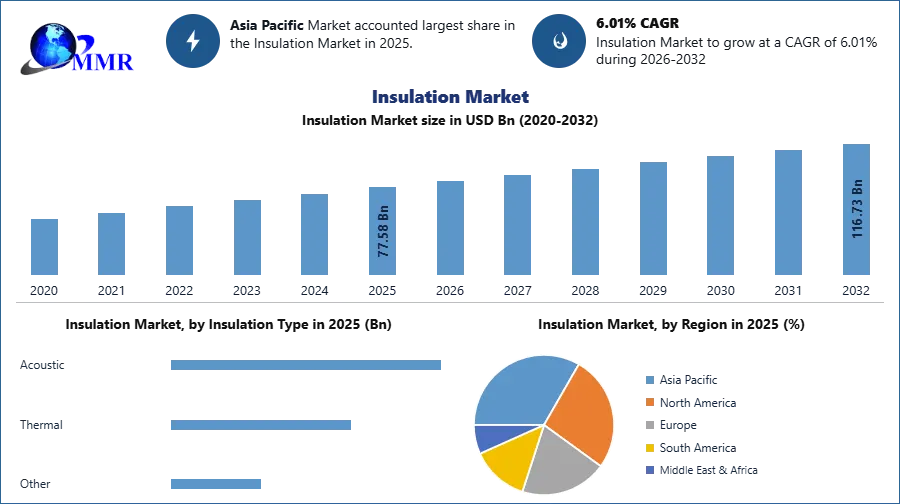
- Global Insulation Market valued at USD 77.58 Billion in 2025.
- Market expected to reach nearly USD 116.74 Billion by 2032.
- Forecast CAGR stands at 6.01% during 2026–2032.
- Energy-efficiency regulations continue to influence adoption across residential, commercial, and industrial sectors.
- Infrastructure modernization and sustainable construction remain primary growth catalysts.
- Manufacturers are expanding investments in advanced insulation materials and environmentally responsible production methods.
- Industrial energy management initiatives are creating new demand channels.
Why This Matters Now
Energy costs are becoming a boardroom issue rather than a facility-management concern. Governments, developers, manufacturers, and infrastructure operators are facing increasing pressure to reduce energy consumption while meeting stricter environmental standards.
The insulation industry sits at the center of this transition. Every investment in thermal efficiency directly affects operating costs, carbon emissions, building performance, and long-term asset value. As construction activity expands and industrial facilities modernize, insulation is moving from a compliance requirement to a strategic investment category.
Market Overview
The global Insulation Market generated USD 77.58 Billion in 2025 and is projected to approach USD 116.74 Billion by 2032, reflecting a CAGR of 6.01%. This growth trajectory signals more than construction demand. It reflects a global shift toward energy optimization across residential buildings, commercial facilities, industrial operations, and infrastructure assets.
What changed is the economic rationale behind insulation investments. Previously viewed as a construction component, insulation is increasingly treated as an operational efficiency tool. Rising electricity costs, sustainability commitments, and stricter building codes are driving broader adoption across both developed and emerging economies.
The result is a market benefiting simultaneously from new construction, infrastructure expansion, industrial upgrades, and building retrofits.
Key Trends Driving Growth
Energy efficiency has become the dominant market driver. Governments and regulatory agencies are introducing stricter building performance requirements, creating sustained demand for advanced insulation solutions. Every improvement in thermal performance reduces heating and cooling requirements, making insulation one of the most cost-effective energy-saving technologies available.
Sustainable construction is reshaping procurement decisions. Developers increasingly evaluate building materials based on lifecycle performance, environmental impact, and regulatory compliance. This trend is encouraging manufacturers to develop products with improved thermal performance and lower environmental footprints.
Infrastructure expansion is creating another growth engine. Transportation networks, industrial facilities, commercial complexes, and public infrastructure projects require extensive insulation systems to improve operational efficiency and reduce maintenance costs.
Industrial modernization is also accelerating adoption. Manufacturing facilities, processing plants, and energy-intensive industries are investing in insulation upgrades to improve productivity and reduce operational expenditures. As industrial energy management becomes a competitive necessity, insulation spending is increasingly viewed as a strategic investment rather than a maintenance expense.
𝐃𝐨𝐰𝐧𝐥𝐨𝐚𝐝 𝐏𝐃𝐅 𝐁𝐫𝐨𝐜𝐡𝐮𝐫𝐞 @ https://www.maximizemarketresearch.com/request-sample/15235/
Segment Insights
- Dominant Segment: Expanded Polystyrene (EPS) insulation held the largest market share due to its lightweight properties, cost efficiency, and strong thermal resistance capabilities. Its widespread use across residential and commercial construction supports continued leadership.
- Fastest-Growing Segment: Glass wool is projected to grow at the fastest rate because of its thermal efficiency, acoustic performance, fire resistance, and sustainability advantages. Increasing emphasis on green building standards further strengthens demand.
- Infrastructure remains the leading end-user segment as governments and private developers continue investing in energy-efficient buildings and modernization programs.
- Transportation is emerging as the fastest-growing application area, supported by demand for lightweight, high-performance insulation solutions that improve thermal management and operational efficiency.
Regional Growth Story
Asia-Pacific continues to shape the industry’s growth trajectory. Rapid urbanization, industrial expansion, and large-scale infrastructure development are generating substantial insulation demand across the region. Government initiatives promoting energy-efficient buildings further reinforce market momentum.
China remains a critical market because of its construction activity, industrial scale, and focus on energy-efficient development. The country’s emphasis on green building practices is accelerating insulation adoption across multiple sectors.
India is emerging as a significant opportunity market. Urban growth, industrial investments, infrastructure projects, and expanding manufacturing activity are creating favorable conditions for insulation suppliers and technology providers.
Europe continues to benefit from stringent environmental regulations and energy-efficiency mandates. Retrofitting aging building stock has become a major demand driver, particularly in markets pursuing aggressive decarbonization goals. Germany remains a regional leader due to strong building standards and government-supported energy modernization programs.
North America is experiencing steady demand driven by commercial construction recovery, energy-efficiency initiatives, and increasing awareness of sustainable building practices.
Competitive Landscape
Competition is increasingly centered on technology, sustainability, manufacturing efficiency, and market reach rather than simple product availability.
Leading companies including GAF Materials Corporation, Huntsman International LLC, Johns Manville, Rockwool International A/S, and DuPont are strengthening their positions through capacity expansion, product innovation, partnerships, and operational improvements.
What these strategies signal is a broader industry transformation. Companies are preparing for a market where customers demand higher thermal performance, stricter regulatory compliance, and stronger sustainability credentials simultaneously.
Raw-material suppliers and insulation manufacturers are also pursuing collaboration models to strengthen supply-chain resilience. As energy efficiency becomes a strategic priority across industries, suppliers with advanced manufacturing capabilities and differentiated product portfolios are likely to gain pricing power and market share.
The competitive advantage increasingly belongs to organizations capable of combining performance, sustainability, and cost efficiency at scale.
Recent Developments
- Manufacturers are increasing investments in advanced production facilities to improve capacity and operational efficiency.
- Strategic partnerships and joint ventures are becoming more common as companies seek broader market access and technology capabilities.
- Sustainability-focused product development is accelerating across major insulation categories.
- Growing emphasis on environmentally responsible construction is influencing research and development priorities.
- Industry participants are pursuing manufacturing optimization initiatives to strengthen competitiveness and profitability.
Strategic Implications
For investors, the insulation sector offers exposure to multiple structural growth themes including energy efficiency, sustainable construction, industrial modernization, and infrastructure development.
For manufacturers, success increasingly depends on innovation, production scalability, and sustainability performance. Companies capable of delivering measurable energy savings while meeting environmental requirements will be positioned to capture premium opportunities.
For governments and infrastructure planners, insulation remains one of the most effective tools for reducing energy consumption and achieving long-term climate objectives.
For developers and industrial operators, insulation investments are becoming financially compelling because they improve operating efficiency, lower energy costs, and support compliance objectives simultaneously.
Future Outlook
The next phase of industry growth will be defined by performance-driven construction, stricter energy regulations, and sustainability-led procurement. Markets that successfully integrate advanced insulation technologies into infrastructure, industrial facilities, and building modernization programs will capture disproportionate economic and environmental benefits.
As energy efficiency becomes a competitive requirement rather than a regulatory objective, the insulation companies that lead in sustainable innovation, manufacturing scale, and performance optimization will define the next generation of market leadership, while slower adopters risk losing relevance in an increasingly efficiency-driven global economy.
Analyst Perspective
“The insulation industry is entering a period where energy efficiency, sustainability, and infrastructure modernization are converging into a single growth opportunity. Organizations that align product innovation with evolving environmental and performance standards will be best positioned to capitalize on long-term market expansion.” — Alpana Patil, Research Analyst
About Maximize Market Research
Maximize Market Research Pvt. Ltd. (MMR) is a global market research and consulting company that provides reliable, data-focused, and practical business insights. The firm serves a wide range of industries, including healthcare, pharmaceuticals, technology, automotive, electronics, chemicals, personal care, and consumer goods. Through market forecasts, competitive analysis, strategic consulting, and industry impact assessments, MMR helps organizations understand changing market conditions, identify growth opportunities, and make informed business decisions for long-term success.
2nd Floor, Navale IT Park Phase 3
Pune Banglore Highway, Narhe
Pune, Maharashtra 411041, India
+91 9607365656
sales@maximizemarketresearch.com






Leave a Reply