
Key Highlights
-
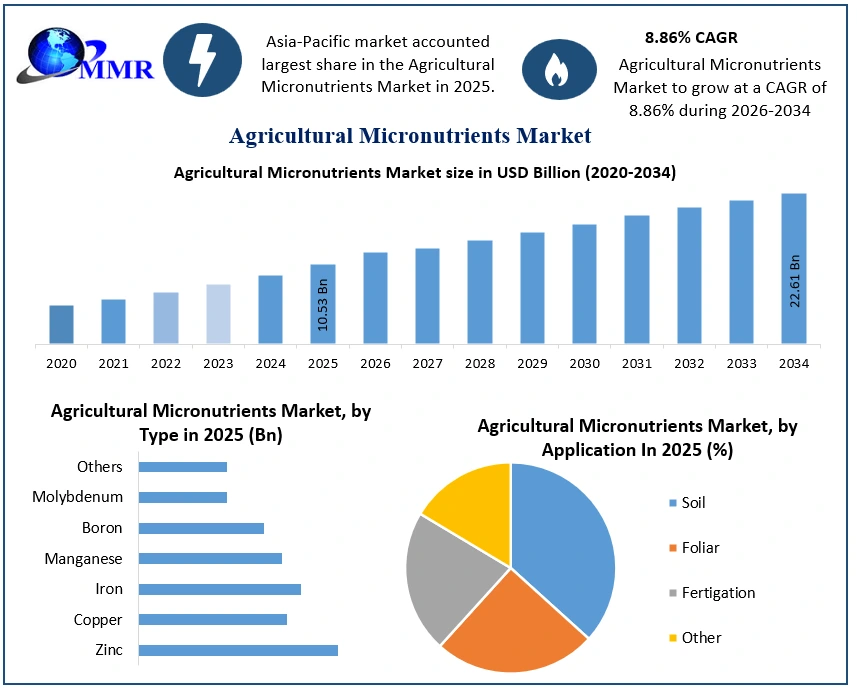
Market Valuation: Valued at USD 10.53 billion in 2025, with a projected trajectory reaching USD 22.61 billion by 2034 under a steady compound annual growth rate of 8.86%.
-
Geographic Leadership: The Asia Pacific region commands the largest market share, anchored by large-scale production across major agricultural hubs like China, India, and Japan.
-
Core Product Dominance: Zinc remains the primary micronutrient in high demand globally to combat widespread membrane integrity failures and severe crop deficiencies.
-
Primary Application Route: Soil application remains the prominent method for large-scale nutrient deployment, while foliar and fertigation methods gain industrial traction.
Why This Matters Now
Shrinking arable land combined with an exploding global population forces chemical manufacturers and agribusiness investors to re-evaluate the resilience of downstream crop inputs. Industrial buyers face immediate supply pressures as baseline soil degradation accelerates across major worldwide farming zones, changing how commodity and specialty chemical producers allocate capital. This shifts the industrial landscape from simple volume-based fertilizer delivery toward targeted, high-margin micronutrient chemical formulations designed to maximize efficiency.
Failing to secure reliable feedstock and scale up chelated or non-chelated processing capacity risks displacing manufacturers as regulatory bodies standardize permissible soil nutrient limits. Agro-industrial procurement leaders must adapt to volatile raw material costs and shifting trade flows to maintain supply chain continuity. For investors and developers, this represents a pivotal window to fund localized specialty chemical production infrastructure before regional supply deficits widen.
Market Overview
The global Agricultural Micronutrients Market is expanding rapidly due to widespread structural shifts in worldwide land utilization and food security mandates. According to recent data from the Food and Agriculture Organization, nearly 80% of global crop production growth by 2030 must come from increased crop yields rather than acreage expansion. Out of 13 billion hectares of total global land, only 1.6 billion hectares are under active farmland production, concentrated heavily across EMEA at 36%, Asia Pacific at 39%, North America at 15%, and Latin America at 10%. This extreme land constraint leaves no choice but intensive cultivation, directly boosting the technical consumption rates of chemical micronutrients per acre.
Rapid worldwide urbanization accelerates the loss of fertile topsoil, creating an immediate operational need for efficient crop protection and structural nutrient replenishment techniques. Micronutrients compose less than 1% of the dry weight of most plants, yet their absence completely halts enzymatic pathways, resulting in stunted harvests and financial losses for industrial farming networks. As a result, global chemical production is shifting toward custom micronutrient blending to address multi-nutrient soil depletion. This shift directly improves long-term soil health and provides higher yield predictability for large-scale farming enterprises.
Key Trends Driving Growth
Widespread sovereign regulatory initiatives act as a major structural driver for market volume, particularly through localized nutrient subsidy modifications. In India, policy mechanisms like the Soil Health Card Scheme, the National Food Security Mission, and the targeted Nutrient Based Subsidy provide direct financial aid to farmers purchasing corrective micronutrient blends. State governments offer direct subsidies to restore localized micronutrient balances, which shields chemical manufacturers from sudden downturns in commodity purchasing power. These structural policies stabilize regional demand, enabling global chemical conglomerates to execute multi-year capacity expansions with lower commercial risk.
Conversely, significant systemic constraints alter the trajectory of market development across emerging economies. Diminishing individual agricultural landholdings, unpredictable monsoons, and poor access to formalized agricultural credit limit the continuous deployment of high-value chemical inputs. Furthermore, a lack of standardized permissible levels from regulatory bodies prevents industrial buyers from determining exact soil injection requirements. This regulatory gap causes volatile purchasing patterns, as farmers hesitate to buy advanced chemical solutions without clear application standards.
Segment Insights
-
Dominant Segment: Zinc formulations hold the largest volume and revenue share in the market due to widespread soil deficiencies across India, Brazil, and China. Zinc is biologically essential to maintain the integrity and stability of plant membranes, preventing the leakage of essential elements from plant surfaces.
-
Fastest-Growing Segment: The fruits and vegetables crop segment is expanding rapidly, driven by rising consumer demand for fresh produce and higher visual and nutritional quality standards. This trend forces growers to use advanced micronutrients like zinc, iron, and molybdenum to protect crops from contamination and ensure healthy yields.
Regional Growth Story
The Asia Pacific region continues to be the dominant manufacturing and consumption hub for agricultural micronutrients, supported by massive downstream volume mandates. India, China, and Japan lead regional consumption due to high-intensity multi-cropping practices and large export footprints for cash crops. India holds a major position in global trade as a primary producer of agricultural products like cashew nuts and fresh fruits, which require precise micronutrient management to maintain export grades. This sustained demand encourages major regional chemical players to invest heavily in specialized research and development to create innovative, climate-adapted product formulations.
In North America and Europe, stringent environmental and runoff regulations alter product selection, favoring chelated delivery systems over cheaper non-chelated alternatives. The North American market, holding 15% of global farmland, benefits from highly mechanized injection infrastructure that allows for precise, automated sub-surface soil applications. Meanwhile, European chemical manufacturers face intense pressure to reduce carbon footprints throughout the lifecycle of micronutrient synthesis. This regulatory pressure shifts production capacity toward high-purity specialty chemicals, altering transatlantic import-export dynamics.
Competitive Landscape
The competitive environment features a mix of global diversified chemical conglomerates and specialized crop nutrition providers aiming to capture market share. Major entities like Yara International, The Mosaic Company, Helena Chemical Company, Nufarm, and Coromandel International dominate core regional distribution channels. Other significant players, including BASF, DOW Chemical, AkzoNobel, Nutrien Ltd., and Compass Minerals International, leverage their backward integration into basic chemical feeds to protect profit margins. This creates an industrial environment where smaller, regional blenders are often acquired by larger firms seeking to expand their geographic reach.
Market concentration is increasing as top-tier producers invest in proprietary chelation technologies to lock in long-term supply agreements with agricultural cooperatives. These corporate strategies focus on developing tailored formulations that blend multiple micronutrients into single, slow-release granules. This reduces application labor costs for commercial growers and enhances product stickiness for chemical brands. Consequently, players without specialized chemical manufacturing assets are facing margin pressure, accelerating consolidation across the global agricultural chemicals sector.
Recent Developments
-
Product Formulation R&D: Leading global manufacturers are increasing capital expenditure for advanced chemical research to develop new micronutrient delivery mechanisms and stabilize shelf lives under varied storage conditions.
-
Portfolio Diversification: Diversified chemical entities like Valagro, Aries Agro Limited, AgroLiquid, and Sigma AgriScience are expanding their specialty portfolios to include organic-complexed micronutrients targeted at premium agricultural sectors.
-
Strategic Corporate Actions: Companies like Haifa Chemicals and Sapec S.A. are optimizing regional logistics assets to reduce transport costs for bulk non-chelated micronutrients amid volatile maritime shipping fees.
Strategic Implications
For chemical manufacturers, the structural transition from commodity bulk fertilizers to specialty micronutrients alters plant utilization strategies and margin structures. Production facilities require precise blending infrastructure and high-grade raw materials, which increases capital entry barriers for potential new entrants. Procurement managers must establish long-term sourcing contracts for key metal inputs like zinc and manganese to protect operations from volatile global metal trading markets. Companies that fail to secure reliable raw material supply lines face immediate production bottlenecks, reducing their ability to fulfill time-sensitive seasonal orders.
Furthermore, the rise of advanced precision agriculture requires chemical companies to work closely with downstream equipment manufacturers. Micronutrient delivery must integrate smoothly with modern liquid fertigation systems and automated drone deployment setups to prevent equipment clogging or uneven distribution. This integration dynamic shifts the product definition from a basic bulk commodity to a complete, service-supported chemical application system. As a result, manufacturers that invest in field-level technical support can command higher pricing power over unbranded commodity competitors.
Future Outlook
The long-term trajectory of the market depends on balancing strict environmental regulations against the urgent global need for higher crop yields. As regulatory bodies implement tighter rules on soil chemical accumulation, the development of biodegradable chelated agents will become a key competitive differentiator for global manufacturers. Companies that rely entirely on old, high-runoff non-chelated formulations face the risk of product bans or shifting consumer preferences in developed agricultural economies. Conversely, firms that align their production with circular economy principles by utilizing recycled industrial metal byproducts will gain structural cost advantages and improve brand equity. The ultimate winners in this space will be chemical manufacturers that successfully industrialize high-purity, targeted-release micronutrients while insulating their raw material supply chains from macroeconomic trade disruptions.
Analyst Perspective
“The severe acceleration of multi-nutrient soil deficiencies across critical agricultural zones is fundamentally changing the role of micronutrients from optional additives to essential industrial inputs. Manufacturers who proactively invest in localized, high-stability chelation capacities will capture significant market share as global supply chains face increasing climate and geopolitical pressures.” — Ankita Kagawade, Lead Analyst, Maximize Market Research
About Maximize Market Research
Maximize Market Research Pvt. Ltd. (MMR) is a global market research and consulting company that provides reliable, data-focused, and practical business insights. The firm serves a wide range of industries, including healthcare, pharmaceuticals, technology, automotive, electronics, chemicals, personal care, and consumer goods. Through market forecasts, competitive analysis, strategic consulting, and industry impact assessments, MMR helps organizations understand changing market conditions, identify growth opportunities, and make informed business decisions for long-term success.
2nd Floor, Navale IT Park Phase 3
Pune Banglore Highway, Narhe
Pune, Maharashtra 411041, India
+91 9607365656
sales@maximizemarketresearch.com









Leave a Reply