
Key Highlights
-
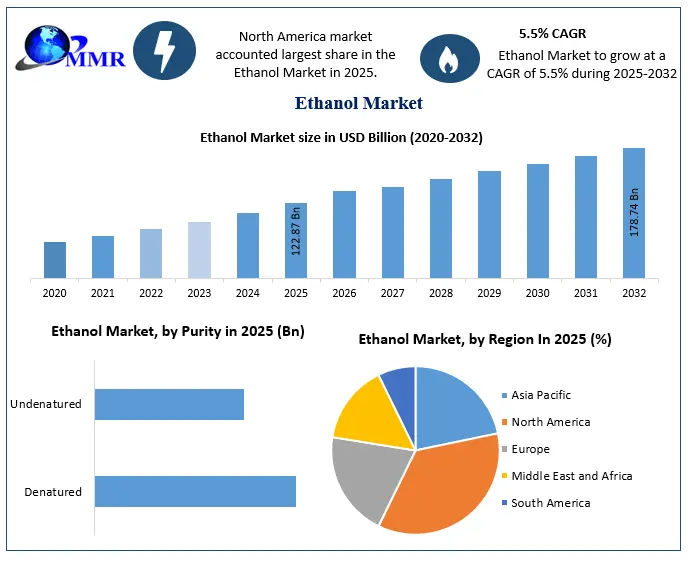
Global Market Scale and Valuation: Global Ethanol Market valued at USD 122.87 Billion in 2025.
-
Forward Projection: Projected to scale steadily to USD 178.74 Billion by 2032, advancing at a 5.5% CAGR.
-
Structural Technology Pivot: Refining facilities optimize advanced distillation architectures to significantly reduce thermal energy consumption during heavy continuous processing runs.
-
Segment Leadership: Grain-based ethanol configurations dominated the global market structure, capturing a 67.6% market share due to highly optimized crop logistics.
-
Environmental Compliance Drivers: Stricter international transportation mandates enforcing E10 and E20 fuel mixtures compel refining industries to secure consistent, high-volume capacity additions.
-
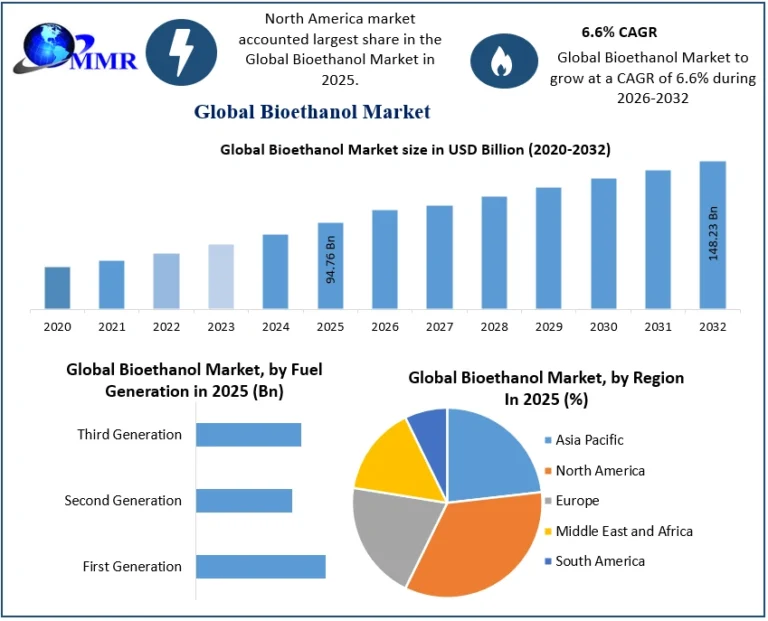
Key Regional Locomotive: North America represents a massive volume powerhouse, supported by vast regional agricultural clusters and deeply integrated commercial biofuel networks.
Why This Matters Now
Global chemical manufacturing groups and industrial fuel refiners can no longer treat renewable alcohols as simple secondary blending agents. For corporate leadership boards, downstream procurement directors, institutional energy investors, and logistics managers, the ethanol production grid has shifted into an essential foundation for regulatory survival. The rapid global push toward strict automotive fuel mandates requires immediate, heavy capital alignment. Processing operations that secure highly resilient regional agricultural feedstock chains will protect their long-term manufacturing margins from global crop volatility. Conversely, conventional refining networks that delay transitioning to high-purity, denatured industrial streams face severe compliance penalties and shrinking access to major commercial supply routes.
Market Overview
The Global Ethanol Market is transitioning away from standard, unmonitored baseline chemical streams into a premium high-efficiency material sector split between heavy transport biofuels and advanced industrial solvents. Achieving a stable valuation of USD 122.87 Billion in 2025, the industry’s progression to USD 178.74 Billion by 2032 highlights an absolute baseline reliance on product purity, asset insulation, and resource conservation. While traditional beverage-grade applications maintain a highly stable, recurring baseline presence, the industry’s primary financial momentum is consolidating inside large-scale automated distillation complexes designed to isolate water molecules without inducing costly thermal energy losses across continuous processing lines.
Advanced material science and automated manufacturing lines are actively restructuring the basic cost profiles of the global industry. The deployment of high-selectivity molecular sieves, specialized enzyme blends, and custom corrosion-resistant stainless steel architectures allows modern ethanol processing units to extend operational life cycles under extreme heat or highly acidic environments. These technical upgrades, coupled with a major push toward modular system architectures, help industrial processing sites minimize installation footprint changes while ensuring full compliance with changing cross-border environmental and blending restrictions.
Key Trends Driving Growth
The steady integration of digital tracking platforms directly into automated bioreactor systems is functioning as an important growth catalyst. Real-time condition-monitoring setups allow engineering teams to track fermentation temperature differentials and cellular yeast health metrics continuously, shifting facility workflows from rigid calendar-based updates to precision predictive material cycles.
Feedstock supply challenges and strict industrial effluent reclamation mandates are expanding the demand for advanced water-recycling purification equipment. Large-scale manufacturing installations are increasingly investing in heavy-duty evaporation arrays and closed-loop liquid separation configurations to clean and recycle process fluids internally, lowering direct primary municipal water expenses.
Rapid industrial expansion across developing global manufacturing clusters is creating a steady pipeline of greenfield machinery and material orders. The concentration of automotive component, specialty chemical, and electronics plants within dedicated economic zones amplifies the necessity for automated air pollution controls and continuous process solvent installations.
Furthermore, multi-national occupational safety agencies continue to implement strict workplace safety and ambient environment regulations. This regulatory pressure forces facility managers to deploy high-purity molecular filter lines and specialized chemical collection systems to safeguard plant floors from hazardous dust or volatile organic compound emissions.
Segment Insights
-
Dominant Segment: Grain-Based Ethanol. Driving the majority of market volume due to its critical availability in scaling agricultural sectors, grain-based manufacturing holds a dominant 67.6% market share. Major buyers include automated fuel blending stations, global chemical solvent processors, and industrial disinfectant manufacturers.
-
Fastest-Growing Purity Segment: Denatured Alcohol. This segment is expanding rapidly across the global marketplace, favored because its chemical formulation bypasses beverage taxes while serving as an efficient base for fuel additives, industrial cleaners, and high-volume sanitizers.
Regional Growth Story
The North American region maintains absolute volume dominance in the global marketplace, driven by massive manufacturing expansions and heavy infrastructure spending across major domestic agricultural states. Local initiatives focused on industrial carbon mitigation and stricter transport fuel monitoring turn the region into an essential volume destination for leading global ethanol brands.
The Asia-Pacific region controls a substantial share of advanced, high-growth ethanol value, supported by automated chemical synthesis labs, specialized pharmaceutical production units, and a robust transport infrastructure assembly base. The regional market benefits from mature corporate adoption patterns that prioritize highly efficient fuel blending mandates and automated refinery retrofits.
In Europe, development paths are guided by strict net-zero manufacturing targets and circular economy rules. European producers lead the way in crafting fully traceable, non-food cellulosic alternative inputs, ensuring compliance with strict regional environmental validation terms. Meanwhile, automated engineering clusters in Japan and South Korea continue to drive breakthroughs in electronic-grade cleaning derivatives and precision solvent integrations.
Competitive Landscape
The global competitive layout features a mix of highly diversified engineering conglomerates and specialized premium biotechnology brands. Industry leaders rely on massive production scale, global logistics networks, and aggressive consolidation strategies to lock in exclusive equipment and material supply agreements with top-tier industrial operators.
To protect their long-term market positions, top manufacturers are focusing heavily on high-value asset acquisitions and the expansion of downstream service networks. Reputable global organizations—such as Archer Daniels Midland (ADM), Valero Energy, The Andersons Inc., Green Plains Inc., British Petroleum (BP), and United Breweries—maintain dominant international supply lines. These market leaders consistently utilize licensed component designs to deliver application-specific solutions directly to international procurement teams.
Smaller regional producers and independent aftermarket suppliers capture market share by offering localized delivery channels and cost-effective replacement components. By specializing in custom configurations for regional industrial clusters, these mid-sized firms remain vital supply partners for localized production facilities.
Recent Developments
-
Cross-Border Infrastructure Pacts (2025–2026): Leading motion and control corporations sign multi-billion dollar definitive agreements to acquire tier-1 biofuel logistics networks, effectively tripling their clean transport and industrial gas distribution capacities.
-
Multi-Million Dollar Bioreactor Investments Completed (Late 2025): Top-tier industrial refiners complete major factory expansions in Europe and North America to meet a massive spike in high-purity separation orders from the automotive and pharmaceutical sectors.
-
Advanced Molecular Sieve Extraction Lines Deployed (Early 2026): Key separation technology developers launch high-efficiency replacement modules designed to integrate easily into existing distillation infrastructure, maximizing environmental protection.
-
High-Capacity Cellulosic Feedstock Acquisitions Finalized (2026): Major industrial brands finalize hundred-million-dollar asset buyouts of agricultural residue processing specialist businesses, securing specialized access to high-performance renewable chemical supply lines.
Strategic Implications
For high-volume chemical processors, automated fuel packaging complexes, and precision transport logistics networks, maintaining a resilient and monitored industrial ethanol supply chain represents an absolute business priority. Facilities must integrate continuous tracking layers and source durable process media to protect delicate high-value processing machinery from catastrophic contamination-related breakdown events.
National environmental development boards must view regional industrial water cleaning networks and emission-reduction infrastructures as foundational assets for economic durability. Governments that establish clear, uniform testing codes and provide upfront incentives for the deployment of smart separation configurations will successfully attract high-value manufacturing investments while protecting regional natural resources.
Future Outlook
The next competitive era will belong to industrial ethanol operators who successfully combine absolute manufacturing scale with data-backed efficiency systems. Operations that target their development spending toward fully integrated continuous distillation loops, low-energy membrane technologies, and alternative non-food cellulosic inputs will secure long-term contracts in tomorrow’s automated industrial economy. Conversely, unhedged component suppliers that stick to unmonitored legacy processing types will face falling profit margins and shrinking access to modern corporate building projects.
Analyst Perspective
“The global ethanol market is entering an era defined by non-negotiable smart integration and predictive processing rules,” says Ankita Kagwade, Analyst at Maximize Market Research. “While traditional liquid and gas separation steps continue to secure huge, reliable baseline order volumes, future value expansion is shifting rapidly toward data-connected systems and verified sustainable filter designs. With the global market scaling toward USD 178.74 Billion by 2032, long-term commercial leadership belongs to producers who embed real-time condition sensors directly into their products. Moving beyond basic component replacements and moving toward automated, performance-driven resource management is now essential for defending processing margins in an increasingly regulated global manufacturing landscape.” – Ankita Kagwade
About Maximize Market Research
Maximize Market Research Pvt. Ltd. (MMR) is a global market research and consulting company that provides reliable, data-focused, and practical business insights. The firm serves a wide range of industries, including healthcare, pharmaceuticals, technology, automotive, electronics, chemicals, personal care, and consumer goods. Through market forecasts, competitive analysis, strategic consulting, and industry impact assessments, MMR helps organizations understand changing market conditions, identify growth opportunities, and make informed business decisions for long-term success.
2nd Floor, Navale IT Park Phase 3
Pune Banglore Highway, Narhe
Pune, Maharashtra 411041, India
+91 9607365656





Leave a Reply