
Key Highlights
-
The global silicone market size was valued at USD 24.27 Billion in 2025 and is expected to reach USD 41.36 Billion by 2034.
-
Market valuation is expanding at a steady compound annual growth rate (CAGR) of 6.1% over the 2026 to 2034 forecast period.
-
The elastomer segment held the dominant position in 2025, supported by broad technical utility across automotive, aerospace, and food contact applications.
-
High-purity silicon feedstock is facing critical volume demand from the monocrystalline and polycrystalline solar PV sectors.
-
Asian chemical companies, notably in China and South Korea, have established structural leadership over global manufacturing capacity.
Why This Matters Now
Procurement leaders and industrial buyers across the electronics, solar, and consumer goods sectors are facing immediate structural cost pressures as silicone supply chains realign around high-purity applications. The rapid scaling of global semiconductor fabrication and green energy infrastructure has positioned high-grade silicone as a critical, non-substitutable input. Any disruption or pricing volatility in the underlying silicon feedstock directly increases component costs for electrical gadgets, sending inflationary ripples throughout the automated food packaging and electronic assembly supply chains.
This material bottleneck forces industrial consumers to re-evaluate their long-term sourcing strategies right now. As regulatory frameworks in advanced economies penalize carbon-intensive processing, chemical manufacturers must rapidly pivot toward sustainable production methods or risk losing access to high-margin Western markets. The window for securing stable, certified clean-purity silicone lines is tightening, separating resilient OEMs from operators exposed to immediate spot-market volatility.
Market Overview
The global silicone market Size entered 2025 with an established valuation of USD 24.27 Billion, establishing a solid baseline for structural expansion up to USD 41.36 Billion by 2034. This trajectory represents a highly consistent 6.1% CAGR, driven by the expanding technical requirements of downstream industrial processors. Derived from primary silicon and oxygen raw materials, these polymers offer a unique combination of chemical resistance, thermal stability, and mechanical flexibility that carbon-based alternatives cannot replicate.
The commercial boundaries of the market are expanding as industrial processes demand materials that can perform under extreme environmental stress. Silicone formulations are designed to handle strict temperature tolerances, electrical insulation requirements, and moisture barriers simultaneously. Consequently, the material is transitioning from a general-purpose industrial additive into a highly specified engineering component across global manufacturing sectors.
Key Trends Driving Growth
The primary driver of modern volume growth is the massive expansion of the global renewable energy infrastructure, specifically solar photovoltaic (PV) generation. In 2022, solar PV generation climbed by a record 270 TWh—a 26% year-on-year increase—to reach approximately 1300 TWh. This ongoing surge in solar capacity demands immense volumes of high-purity silicone to produce and protect photovoltaic cells, with monocrystalline silicon variants increasingly favored due to their superior conversion efficiency.
Concurrently, the microelectronics and semiconductor sectors are undergoing continuous technological breakthroughs, yielding highly sophisticated and powerful hardware. Silicone serves as a versatile semiconductor material and encapsulation matrix that protects delicate circuitry from mechanical shock and thermal failure. This technological shift ensures that as global computing demand intensifies, the volumetric consumption of specialized electronic-grade silicone scales in lockstep.
Segment Insights
-
Elastomers (Dominant Segment): The elastomer segment held the dominant position in the global market in 2025, driven by its exceptional ability to withstand extreme temperature ranges from -60°C to 250°C. This thermal tolerance makes it essential for automotive seals, aerospace components, and durable materials in the packaged food industry.
-
Fluids & Resins: These core product types target specialized industrial processes, personal care formulations, and protective coatings, offering vital lubrication and weatherproofing capabilities.
-
Electronic & Solar Grade (Fastest-Growing Segment): Driven by chip fabrication and clean-energy infrastructure, high-purity chemical grades are outpacing basic metallurgical variants in value growth.
-
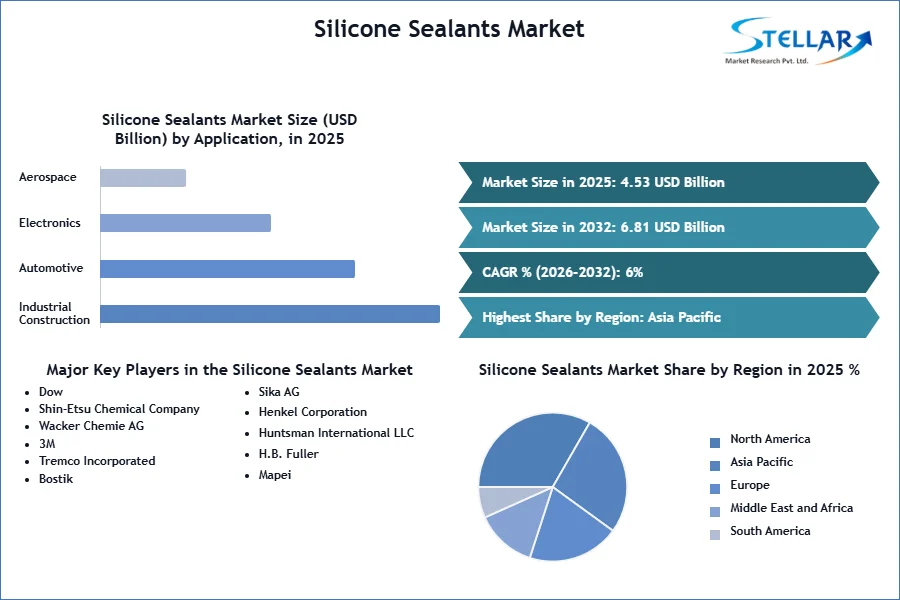
Industrial Processes and Construction (Dominant Application Segments): Structural glazing, sealants, and heavy industrial processing consume the largest baseline volumes of silicone polymers globally.
Regional Growth Story
The Asia-Pacific region functions as the production powerhouse and primary demand engine of the global silicone market. Taiwan maintains a central position in this ecosystem as the world’s largest manufacturer of semiconductors, commanding over half of global electronic production. This concentration of high-technology fabrication creates a massive, permanent local demand for electronic-grade silicon and specialized silicone encapsulants. Furthermore, Asian chemical corporations, particularly inside China and South Korea, have successfully consolidated their market positions by leveraging low-cost energy assets and integrated supply chains to capture global volume market share.
Across Europe, the market narrative is defined by a rigorous focus on sustainability and environmental mandates. The region is anticipated to hold a highly significant market share, driven directly by increasing environmental regulations that propel the development and use of recyclable, eco-friendly silicone alternatives. European buyers are actively prioritizing suppliers that can verify low-carbon manufacturing processes and implement circular economy practices within the packaged food and consumer product sectors.
Competitive Landscape
The global silicone competitive arena is highly dynamic and increasingly shaped by the assertive expansion of major chemical entities across Asia. Western legacy producers are facing intense pricing competition from scaled production assets in China and South Korea, which has fundamentally reshaped global pricing power and capacity utilization. To protect profit margins, established leaders like Shin-Etsu Chemical, Wacker Chemie, Dow Inc., and Evonik Industries are shifting their capital allocations away from low-margin commodity fluids toward high-margin specialty polymers.
This competitive pressure is triggering a wave of strategic reinvestments focused on technical differentiation. Companies are actively modifying their production lines to accommodate eco-friendly manufacturing practices and satisfy strict corporate ESG mandates. By engineering specialized silicone formulations tailored for specific high-growth niches—such as automated electronics testing or sustainable food contact materials—leading players are creating defensive moats against basic bulk chemical imports.
Recent Developments
-
Multi-national chemical producers are restructuring their legacy operations to integrate environmentally friendly production practices, minimizing hazardous byproducts during primary synthesis.
-
Specialty manufacturers are introducing advanced sustainable silicone alternatives specifically engineered for the eco-friendly packaged food sector.
-
Production facilities in key Asian manufacturing hubs are expanding high-purity monocrystalline silicon processing capacities to eliminate volume constraints in the surging solar PV market.
-
Regulatory compliance teams are implementing strict monitoring frameworks to align silicone polymer compositions with evolving European eco-label requirements.
Strategic Implications
For industrial procurement organizations, the ongoing transformation of the silicone market dictates a definitive shift away from transactional purchasing toward strategic lifecycle management. Buyers can no longer treat silicone elastomers or fluids as generic commodities that can be substituted smoothly on the spot market. Because high-purity silicone quality directly controls the defect rates in semiconductor lines and the conversion efficiency of solar panels, establishing multi-year supply partnerships with certified tier-one producers is crucial.
On the manufacturing front, chemical companies must aggressively optimize their feedstock supply chains. Fluctuations in the production costs of elemental silicon and disruptions in regional logistics networks continue to pose major financial risks to operational continuity. Developing domestic raw material security and investing in flexible, multi-product synthesis plants will distinguish high-performing chemical operators from those vulnerable to localized resource crunches.
Future Outlook
The long-term trajectory of the global silicone market will be dictated by how effectively manufacturers balance aggressive volume expansion with rising environmental constraints. While traditional silicone elastomers will sustain a massive baseline volume share due to their unmatched physical resilience across automotive and aerospace applications, the highest margins will reside entirely within the electronic and clean-energy sectors. Chemical corporations that successfully commercialize sustainable alternatives and align their manufacturing assets with the technical demands of advanced chip fabricators will capture dominant market share, while slow-moving suppliers will face margin contraction and shrinking access to premium global markets.
Analyst Perspective
“The global silicone market is operating at the center of the world’s twin transitions: digitalization and decarbonization. As semiconductor architectures grow more complex and solar installations achieve unprecedented deployment rates, silicone has evolved from a basic industrial sealant into an irreplaceable driver of advanced engineering. The companies that will maintain true market leadership are those that can successfully scale up high-purity, electronic-grade capacities while meeting the strict circular economy mandates expanding across Western markets.” — Yash Ghosalkar, Chemical and Materials Analyst, Maximize Market Research
About Maximize Market Research
Maximize Market Research Pvt. Ltd. (MMR) is a global market research and consulting company that provides reliable, data-focused, and practical business insights. The firm serves a wide range of industries, including healthcare, pharmaceuticals, technology, automotive, electronics, chemicals, personal care, and consumer goods. Through market forecasts, competitive analysis, strategic consulting, and industry impact assessments, MMR helps organizations understand changing market conditions, identify growth opportunities, and make informed business decisions for long-term success.
2nd Floor, Navale IT Park Phase 3
Pune Banglore Highway, Narhe
Pune, Maharashtra 411041, India
+91 9607365656
sales@maximizemarketresearch.com




Leave a Reply