
Key Highlights
-
Market Valuation: The global Oilfield Chemical market was valued at USD 31.31 billion in 2025.
-
Growth Forecast: The market is projected to reach USD 44.66 billion by 2032, expanding at a CAGR of 5.2%.
-
Dominant Segment: Corrosion and scale inhibitors currently lead market share, essential for protecting critical infrastructure in mature fields.
-
Key Driver: Rising global energy demand and the need for cost-effective extraction from complex and unconventional reservoirs.
-
Regional Leadership: North America remains the primary market, bolstered by extensive drilling activities and robust production infrastructure.
Why This Matters Now
Energy operators are facing a “maturity paradox”: aging assets require intensive chemical intervention to maintain output, while simultaneously facing pressure to optimize costs and meet decarbonization mandates. For chemical manufacturers and procurement leaders, this creates a dual mandate. You must now deliver high-performance molecules that don’t just extract more oil, but do so with lower toxicity and higher reliability. The market’s shift toward a 5.2% CAGR is a direct response to these operational bottlenecks.
Market Overview
Oilfield chemicals are the invisible backbone of the global energy supply chain. These specialized formulations—ranging from drilling fluid additives that maintain hydrostatic pressure to demulsifiers that separate crude from water—are essential for every stage of the upstream lifecycle.
Oilfield Chemical Market Size Valued at USD 31.31 billion in 2025, the market is on a steady path to reach USD 44.66 billion by 2032. This growth is not merely a result of increased drilling volume; it reflects a fundamental change in the complexity of upstream operations. As operators drill deeper and target unconventional reservoirs, the demand for precision chemistry to handle extreme temperatures and pressures has become a non-negotiable component of production economics.
Key Trends Driving Growth
The industry is currently defined by a move toward “smarter” chemistry. Digitalization of the oilfield is enabling real-time monitoring of chemical injection, allowing operators to use smaller volumes more effectively. This shift toward precision dosing prevents waste and aligns with ESG-driven initiatives to reduce the chemical footprint of drilling operations.
Furthermore, supply chain resilience has emerged as a top-tier priority. Recent volatility in raw material costs—specifically for bromine and barite—has forced manufacturers to rethink their sourcing strategies. We are seeing a move away from just-in-time commodity procurement toward strategic partnerships that guarantee supply for high-demand, high-performance formulations.
Segment Insights
-
Dominant Segment (Product): Corrosion and Scale Inhibitors. These remain the largest segment, as preventing metal degradation in aging tubulars is the single most effective way to avoid expensive, unplanned downtime.
-
Fastest-Growing Segment (Product): Demulsifiers. As water-cut percentages rise in mature fields, the necessity for high-efficiency separation technology is growing, with this segment currently leading in terms of innovation and CAGR.
-
Dominant Segment (Application): Drilling and Cementing. This remains the highest contributor to market volume, driven by the continuous need for fluid additives that maintain wellbore stability under high-pressure, high-temperature (HPHT) conditions.
Regional Growth Story
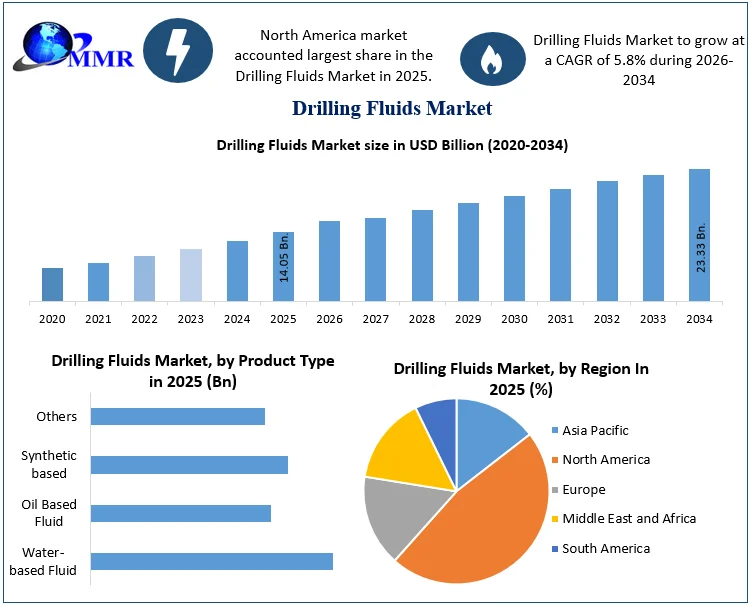
North America holds the market leadership position, driven by the U.S. shale revolution and a concentrated push for maximum production efficiency. The infrastructure here is heavily geared toward chemical-intensive hydraulic fracturing and stimulation, ensuring a stable, high-volume market for upstream chemical providers.
Asia-Pacific, led by China and India, represents the most dynamic expansion opportunity. As these nations strive for energy independence, they are investing heavily in both conventional and unconventional exploration. While regulatory landscapes in these regions are evolving, the sheer scale of the energy demand ensures that Asia-Pacific will be a critical growth engine for chemical suppliers through 2032.
Competitive Landscape
The competitive landscape is transitioning from a commodity-supplier model to one of integrated service partnerships. Major multinational chemical providers are increasingly aligning their R&D budgets with the technical requirements of service companies.
Acquisitions and partnerships are common as firms attempt to gain “molecule-to-application” control. By owning the entire process—from specialized corrosion inhibition formulations to the hardware that injects them—these players are successfully securing significant pricing power. Future competitive advantage will not just go to the best chemist, but to the firm that can prove their chemistry lowers the “Total Cost of Ownership” for the operator.
Recent Developments
-
Advanced Formulation Innovation: Increased R&D focus on low-toxicity, bio-degradable inhibitors that meet the stringent environmental regulations now common in North America and Europe.
-
Vertical Strategic Alliances: Major service providers are formalizing long-term supply agreements for specialty polymers, ensuring they are insulated from the raw material price spikes seen in previous years.
-
Digital Integration: Rapid adoption of AI-enabled chemical dosing systems that optimize the injection rate of surfactants, directly reducing waste and lowering operational overhead for upstream producers.
Strategic Implications
For procurement leads, the market trajectory suggests a move toward contract structures that value performance metrics (e.g., uptime, corrosion mitigation rates) over unit-cost per liter. For investors, the opportunity lies in mid-cap chemical manufacturers that have carved out niches in high-performance demulsifiers or environmentally compliant polymers. The transition to asset-oriented deal-making is effectively signaling a period where technical superiority in extreme conditions is the only viable path to long-term profitability.
Future Outlook
The winners in this market will be the suppliers who successfully pivot from selling volumes to selling operational reliability; those who fail to integrate their chemical portfolios with digital monitoring solutions will struggle to remain competitive as operators demand higher transparency and efficiency from their upstream chemical spend.
Analyst Perspective
“The oilfield chemicals industry is experiencing a necessary reset, where the focus has shifted from mere volume supply to targeted, performance-based intervention. With a CAGR of 5.2%, the market’s trajectory to USD 44.66 billion is driven by the necessity for chemical precision in increasingly difficult reservoirs. Companies that can bridge the gap between complex molecular science and real-time field performance will lead the next decade of upstream operations,” says Ankita Kagawade, Analyst at Maximize Market Research.
About Maximize Market Research
Maximize Market Research Pvt. Ltd. (MMR) is a global market research and consulting company that provides reliable, data-focused, and practical business insights. The firm serves a wide range of industries, including healthcare, pharmaceuticals, technology, automotive, electronics, chemicals, personal care, and consumer goods. Through market forecasts, competitive analysis, strategic consulting, and industry impact assessments, MMR helps organizations understand changing market conditions, identify growth opportunities, and make informed business decisions for long-term success.
2nd Floor, Navale IT Park Phase 3
Pune Banglore Highway, Narhe
Pune, Maharashtra 411041, India
+91 9607365656
sales@maximizemarketresearch.com




Leave a Reply