
Key Highlights
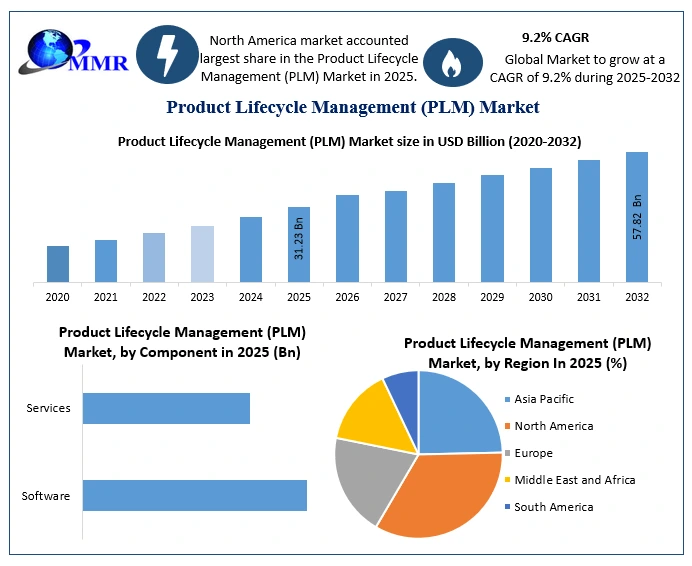
- Product Lifecycle Management (PLM) Market valued at USD 31.23 Billion in 2025
- Expected to reach USD 57.82 Billion by 2032, growing at 9.2% CAGR
- Expansion driven by cloud-based PLM platforms and enterprise digital transformation
- AI and automation reshape engineering design, simulation, and lifecycle governance
- Strong adoption across manufacturing, automotive, aerospace, and high-tech sectors
- Rising demand for integrated product data ecosystems and digital thread architectures
Why This Matters Now
Product development cycles are collapsing under pressure from AI-driven design tools, global supply chain volatility, and accelerated product innovation timelines. Enterprises are shifting PLM from legacy engineering repositories to cloud-native, intelligence-driven platforms.
For CIOs and CTOs, PLM is no longer an engineering support system. It has become a core digital infrastructure layer connecting design, manufacturing, supply chain, and after-sales ecosystems in real time.
Market Overview
The Product Lifecycle Management (PLM) Market is evolving into a strategic enterprise software layer that governs end-to-end product intelligence. At USD 31.23 Billion in 2025, the market reflects accelerating enterprise demand for unified product data environments that integrate engineering, manufacturing, and service workflows.
The projected rise to USD 57.82 Billion by 2032, at a CAGR of 9.2%, signals structural adoption rather than cyclical growth. Enterprises are shifting toward digital thread architectures that unify data across the entire lifecycle of products, from ideation to retirement.
This transformation is tightly linked to cloud computing adoption, SaaS-based engineering platforms, and AI-enabled simulation tools that reduce product iteration cycles and improve time-to-market performance.
Key Trends Driving Growth
Cloud migration is the dominant structural force reshaping PLM deployment models. Enterprises are abandoning on-premise engineering systems in favor of scalable, cloud-native PLM platforms that support global collaboration and real-time data synchronization.
Artificial intelligence is becoming embedded in PLM workflows. AI-driven generative design, predictive maintenance modeling, and automated compliance validation are reducing manual engineering workload and improving decision accuracy.
Digital twin integration is accelerating across manufacturing and industrial ecosystems. PLM platforms now serve as the data backbone for virtual product replicas used in simulation, testing, and lifecycle optimization.
Cybersecurity is emerging as a critical layer within PLM ecosystems. As product data becomes distributed across cloud environments and global supply chains, enterprises are prioritizing secure access control, encryption, and regulatory compliance frameworks.
Telecom-grade connectivity improvements, including 5G and edge computing, are enabling real-time PLM collaboration across geographically distributed engineering teams, particularly in automotive and aerospace sectors.
Segment Insights
- Dominant Segment: Not specified in the supplied report extract
- Fastest-Growing Segment: Not specified in the supplied report extract
Despite limited segmentation disclosure, enterprise adoption trends indicate strong momentum toward cloud-based PLM platforms and integrated SaaS engineering ecosystems. The shift is being driven by demand for faster deployment cycles, lower infrastructure costs, and global accessibility.
Regional Growth Story
North America remains a leading hub for PLM adoption due to advanced manufacturing ecosystems, high enterprise software penetration, and strong investment in AI-driven engineering platforms. The United States continues to anchor innovation in cloud PLM and digital thread deployment.
Europe is advancing PLM adoption through industrial modernization programs, particularly in Germany’s automotive and engineering sectors. Regulatory compliance requirements are also pushing enterprises toward structured lifecycle data governance.
Asia-Pacific is emerging as a high-growth region, driven by manufacturing expansion in China, India, Japan, and South Korea. Rapid industrial digitization, combined with increasing investment in smart factories and industrial IoT, is expanding PLM deployment across mid-sized enterprises.
However, region-specific dominance and quantified leadership details are not specified in the provided report data.
Competitive Landscape
The PLM ecosystem is consolidating around platform-centric software providers that integrate design, engineering, manufacturing, and analytics into unified environments. Competition is shifting from feature-based differentiation to ecosystem control and data interoperability.
Cloud-native PLM providers are gaining structural advantage over legacy on-premise vendors by enabling continuous software updates, API-driven integration, and AI model embedding. This shift signals a broader transition toward platform economics in industrial software.
Enterprise buyers are prioritizing vendors that can deliver end-to-end digital thread capabilities rather than standalone lifecycle modules. This is reshaping procurement strategies in aerospace, automotive, and industrial manufacturing sectors.
Strategically, partnerships between PLM vendors, cloud providers, and semiconductor/edge computing firms are expanding. These alliances indicate convergence between industrial software and hyperscale cloud infrastructure.
The competitive frontier is no longer engineering functionality alone. It is data ownership, AI integration depth, and ability to orchestrate multi-enterprise product ecosystems across global supply chains.
Recent Developments
- Expansion of cloud-based PLM deployments across global manufacturing enterprises
- Increasing integration of AI-driven design automation and generative engineering tools
- Rising adoption of digital twin frameworks linked to PLM systems
- Strong enterprise focus on cybersecurity and data governance in product lifecycle systems
- Growth in SaaS-based PLM subscription models replacing traditional licensing structures
Strategic Implications
PLM is becoming a central intelligence layer for enterprise digital transformation. Companies that modernize toward cloud-native PLM systems gain faster innovation cycles, improved collaboration, and stronger supply chain resilience.
AI integration is redefining engineering productivity. Automated design optimization and predictive lifecycle analytics are reducing dependency on manual engineering iterations.
For telecom and cloud providers, PLM expansion increases demand for high-bandwidth, low-latency infrastructure, especially as engineering workflows move toward real-time global collaboration and edge-enabled simulation.
Enterprises that fail to integrate PLM into broader digital transformation strategies risk fragmented product data environments, slower time-to-market, and reduced competitiveness in AI-driven manufacturing ecosystems.
Future Outlook
The PLM market is transitioning from a design management tool to a strategic digital backbone for intelligent enterprises, where AI, cloud, and connected engineering ecosystems determine industrial competitiveness.
Analyst Perspective
“Product Lifecycle Management is no longer confined to engineering departments. It is becoming the control layer for enterprise product intelligence, where AI, cloud, and digital twins converge to define how fast and how intelligently industries innovate,” said Yash Ghosalkar, Analyst.
About Maximize Market Research
Maximize Market Research Pvt. Ltd. (MMR) is a global market research and consulting company that provides reliable, data-focused, and practical business insights. The firm serves a wide range of industries, including healthcare, pharmaceuticals, technology, automotive, electronics, chemicals, personal care, and consumer goods. Through market forecasts, competitive analysis, strategic consulting, and industry impact assessments, MMR helps organizations understand changing market conditions, identify growth opportunities, and make informed business decisions for long-term success.
2nd Floor, Navale IT Park Phase 3
Pune Banglore Highway, Narhe
Pune, Maharashtra 411041, India
+91 9607365656
sales@maximizemarketresearch.com






Leave a Reply