
Key Highlights
-
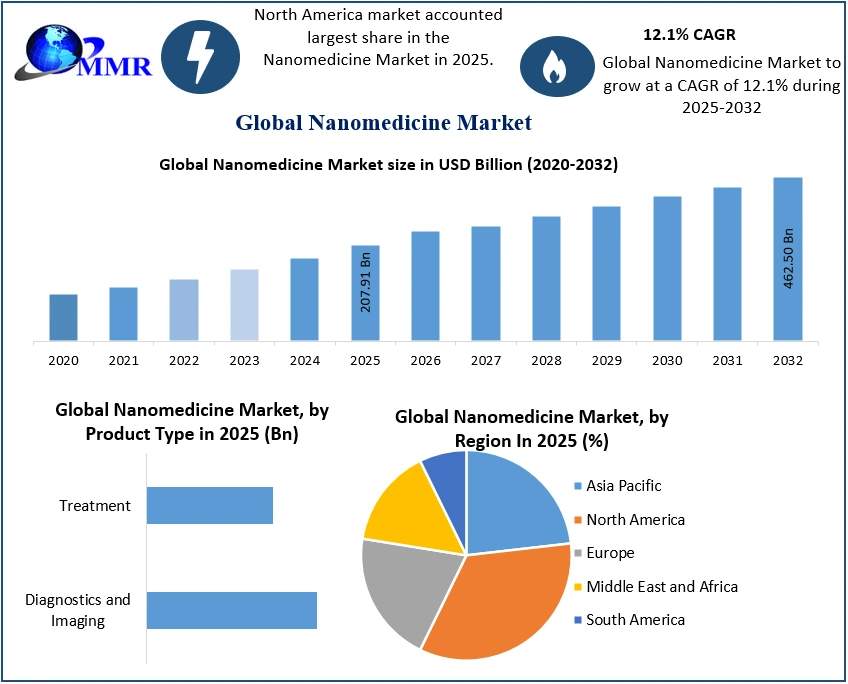
The global nanomedicine market size reached USD 207.91 billion in 2025 and is projected to scale to USD 462.50 billion by 2032, expanding at a compound annual growth rate (CAGR) of 12.1%.
-
The diagnostics segment emerged as a massive revenue center during recent public health crises, driven by a surge in nanoparticle-based rapid antigen assays and biosensors.
-
Large pharmaceutical companies and agile biotech firms are rapidly commercializing synthetic nanocarriers to achieve site-specific oncology therapeutics.
-
China has institutionalized nanotechnology infrastructure through its 13th Five-Year Plan and specialized state-sponsored industrial zones like Suzhou’s ‘Nanopolis.’
-
Medtronic PLC expanded its structural hardware portfolio by launching the Adaptix Interbody System, which features sub-micron Titan nanoLOCK Surface Technology.
Why This Matters Now Oncology programs and cellular therapy pipelines face severe financial pressure as healthcare networks demand evidence of superior patient outcomes to justify high drug pricing. Legacy systemic chemotherapies often fail cost-benefit analyses due to severe off-target toxicity and high rates of hospital re-admission. Integrating engineered nanomaterials into active drug development allows pharmaceutical executives to protect expiring molecular patents and improve therapeutic indices.
For institutional investors and life sciences boards, clinical-grade nanotechnology represents the primary tool for executing precision medicine at scale. The successful deployment of messenger RNA (mRNA) vaccines established lipid nanoparticles as a reliable, commercially viable delivery vehicle. Corporate asset allocation is shifting from broad small-molecule portfolios toward target-specific nanomedicines capable of crossing complex biological barriers.
Market Overview The global nanomedicine market consists of nanoscale materials, biocompatible nanocarriers, and automated nanobots designed to prevent, diagnose, and treat complex conditions. The foundational market value stood at USD 207.91 billion in 2025. Broadening pipeline validations and massive infrastructure investments will propel the total sector valuation to USD 462.50 billion by 2032. This growth pathway represents a stable 12.1% CAGR over the seven-year forecast period.
The demand landscape is shaped by rising global disease burdens, specifically a structural surge in chronic conditions like cardiovascular ailments, diabetes, and neurodegenerative illnesses. Global dementia and Alzheimer’s cases are forecasted to double every 20 years, creating an urgent clinical need for therapeutics that can successfully cross the blood-brain barrier. However, commercial scaling faces headwinds from high manufacturing costs, intricate safety profiling, and ambiguous global regulatory guidelines that evaluate nanomedicines across fragmented drug, device, and biologic pathways.
Key Trends Driving Growth Oncology treatment continues to transition toward personalized, non-toxic alternatives, driving immediate commercial demand for engineered nanomaterials and functionalized nanoplatforms. These sub-micron architectures exploit the enhanced permeability and retention effect of tumor tissue, concentrating active pharmaceutical ingredients inside malignant cells while sparing healthy tissue. This specialized delivery method improves patient tolerability and helps support value-based insurance reimbursement models.
Concurrently, the integration of nanotech into orthopedic and structural implants is changing surgical outcomes. Advanced manufacturing methods allow developers to texturize the surface layers of medical devices at the nanoscale, encouraging faster bone integration and reducing implant rejection rates. These surface modifications lower the risk of chronic post-surgical infections, directly cutting long-term hospital operational costs.
𝐃𝐨𝐰𝐧𝐥𝐨𝐚𝐝 𝐏𝐃𝐅 𝐁𝐫𝐨𝐜𝐡𝐮𝐫𝐞 @ https://www.maximizemarketresearch.com/request-sample/39223/
Key Trends Driving Growth
-
Diagnostics (Dominant Revenue Segment): Generating the maximum revenue share during recent global health crises, this segment leads due to the deployment of rapid nanoparticle assays and nano-biosensors. These tools utilize metallic nanoparticles and graphene to detect viral proteins and antibodies with higher sensitivity than traditional laboratory methodologies.
-
Oncology and Targeted Delivery: This application area represents a high-growth sector because of the clinical push to replace systemic chemotherapy with nanocarriers. Major pharmaceutical firms are prioritizing capital allocations for lipid, polymeric, and gold nanoparticles to maximize localized drug accumulation.
-
Structural Market Segmentation: The broad market structure is organized by technology, application, and material type. Key materials include nanoparticles, nanotubes, nanocrystals, liposomes, and dendrimers. Applications encompass therapeutics, diagnostics, regenerative medicine, and personalized tools.
Regional Growth Story China has emerged as a major epicenter in the global nanomedicine market, positioning itself as a challenger to Western leadership through aggressive state funding. The Chinese government prioritized nanotechnology within its 13th Five-Year Plan, backing the sector with state research grants, rapid regulatory processing, and specialized academic infrastructure. This state-led strategy operates through the National Center for Nanoscience and Technology (NCNST) and dedicated industrial clusters such as Suzhou’s ‘Nanopolis,’ which contains both indigenous startups and multinational corporations. Furthermore, competitive local salaries and extensive laboratory budgets continue to attract foreign-trained Chinese scientists back to domestic enterprises like Array Nano and Nano Medtech. This domestic talent pool has driven local breakthroughs in synthetic nanoparticle synthesis for gene editing and laser-controlled nanobots.
North America maintains a highly competitive position, driven by private capital deployment, premium healthcare expenditure, and a clear regulatory history for advanced biologics. United States market participants, including Pfizer Inc. and Celgene Corporation, leverage a mature venture ecosystem to fund large-scale human clinical trials. The presence of advanced research hospitals ensures rapid clinical trial enrollment and immediate provider adoption of newly approved nanopharmaceuticals.
In Europe, development centers on public-private consortiums in Germany, the United Kingdom, and France. European biotech firms, such as Nanobiotix, focus heavily on radio-enhancer nanoparticles designed to amplify radiation therapy outcomes in solid tumors. In the Asia-Pacific region outside of China, Japan and South Korea lead development by applying advanced nanomaterials to miniaturized diagnostic hardware and wearable health-monitoring sensors.
Competitive Landscape The competitive structure of the nanomedicine industry is defined by an accelerating race to secure proprietary nanocarrier manufacturing technologies. Large pharmaceutical entities are using targeted acquisitions and co-development licensing deals to capture specialized delivery platforms from early-stage biotechnology startups. This consolidation allows legacy drug companies to reformulate existing therapeutics into patent-protected nanomedicines.
Simultaneously, medical device innovators are forming partnerships with surface-chemistry specialists to launch upgraded structural hardware. Companies are defending their market share by adding antimicrobial and osseointegrative nanoscale coatings directly onto their core product lines. This focus on material science helps differentiate products in crowded purchasing markets like orthopedic surgery and interventional cardiology.
Recent Developments
-
Medtronic PLC expanded its commercial spine surgery line by launching the Adaptix Interbody System, featuring sub-micron Titan nanoLOCK Surface Technology to encourage local bone growth.
-
Innovasis Inc. secured formal regulatory clearance from the United States Food and Drug Administration (FDA) for its 3D-printed spinal implants utilizing Promimic’s specialized HAnano Surface Technology.
-
Academic institutions working with the Chinese Academy of Sciences (CAS) demonstrated synthetic nanoparticle vehicles capable of precise gene editing inside complex cellular environments.
-
BioNTech and Pfizer Inc. expanded global production lines for the BNT162b2 mRNA vaccine, solidifying lipid nanoparticles as a standard delivery model for commercial therapeutics.
Strategic Implications The lack of a unified global regulatory definition for nanomedicines forces developers to navigate highly complex approval pathways managed by the Central Drugs Standard Control Organization (CDSCO) and the FDA. Corporations must clear rigorous risk-based classifications, extensive stability testing, and detailed pharmacovigilance tracking before securing commercial marketing authorizations. These stringent clinical trial requirements raise the initial barrier to entry, favoring well-capitalized pharmaceutical organizations over smaller firms.
From a pricing perspective, national price control frameworks, such as India’s Drug Price Control Order (DPCO), directly cap profit margins on scheduled medical formulations. Manufacturers must build highly efficient, scalable manufacturing processes to maintain profitability under strict regional price limits. Consequently, long-term market viability depends on optimizing manufacturing yields and protecting global intellectual property portfolios through robust patents.
Future Outlook The global nanomedicine landscape will shift over the next decade from basic passive drug carriers to autonomous, responsive nanorobotic systems. Future therapeutic platforms will navigate the human circulatory system in real time, executing cellular repairs and releasing microscopic drug doses only when encountering specific disease biomarkers. This technological shift will reward life sciences enterprises that successfully combine molecular diagnostics, advanced material science, and automated manufacturing lines. Conversely, pharmaceutical organizations that continue to rely on traditional, non-targeted small-molecule therapies will face eroding market shares and lower insurance reimbursement rates. Future market leaders will be defined by their ability to manufacture stable, target-specific nanomaterials at a commercial scale, while lagging firms remain constrained by generic, systemic formulations.
Analyst Perspective “The validation of lipid nanoparticles during recent public health challenges has permanently changed how the pharmaceutical industry approaches drug delivery. Nanomedicine is transitioning from an academic research focus into an essential commercial manufacturing standard for complex therapeutics. Companies that build scalable, high-yield nanomaterial production lines will capture the next generation of oncology and neurology market budgets.” — Komal Patil, Research Analyst, Maximize Market Research




Leave a Reply