
Key Highlights
-
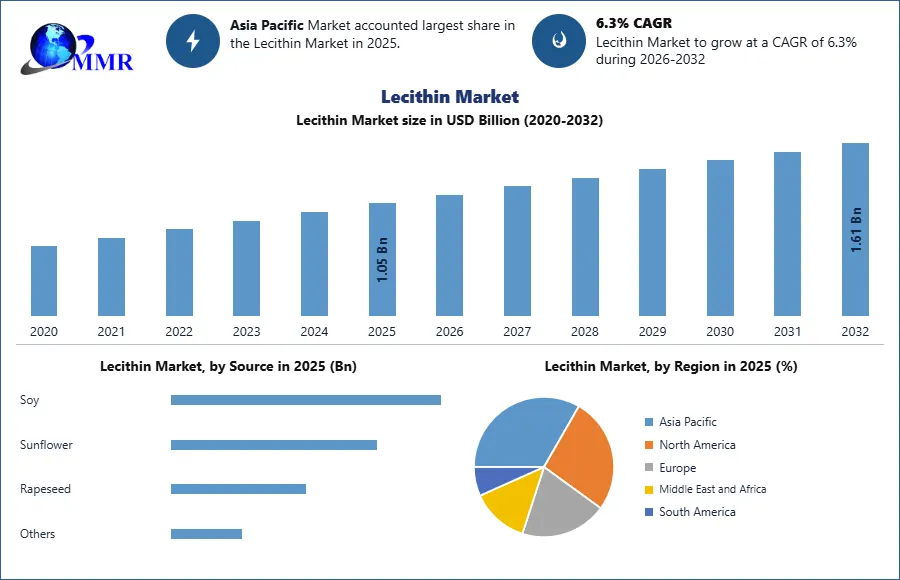
The global lecithin market value will grow from USD 1.05 billion in 2025 to USD 1.61 billion by 2032, advancing at a 6.3% compound annual growth rate.
-
The soy source segment retains dominant control over the global market footprint due to its widespread availability and established texturizing efficiency.
-
Pharma grade lecithin is positioned to secure the highest segment market share by 2030, driven by its medical utility in treating liver and neurological disorders.
-
North America represents the fastest-growing regional market, propelled by deep consumer spending on premium dietary supplements and functional hair care formulations.
-
Emerging environmental and sustainability concerns regarding standard soy cultivation are driving corporate interest in alternative botanical extraction channels.
Why This Matters Now
Food and pharmaceutical formulation executives face an immediate supply risk if their texturizing portfolios rely on synthetic chemical stabilizers. Regulatory bodies and retail buyers are systematically squeezing out artificial emulsifiers, forcing an immediate pivot toward plant-derived alternatives that protect product stability without compromising clean labels. This structural shift means that any manufacturer failing to lock in high-purity natural lecithin contracts will find their items disqualified from premium retail portfolios.
Furthermore, emerging environmental objections surrounding legacy soy sourcing are introducing immediate volatility into raw material supply chains. High-volume brands can no longer rely on unverified bulk soy inputs without risking corporate sustainability pushback and consumer boycotts. Procurement teams must act immediately to diversify into certified sustainable non-GMO crops or face sudden cost shocks as standard soy extraction faces stricter environmental mandates.
Market Overview
The Lecithin Market physical construction of modern processed foods and clinical delivery systems depends fundamentally on precise structural emulsion. Lecithin represents a natural fat-based compound prized for its ability to bind oil and water phases seamlessly while simultaneously supplying essential fatty nutrients. This versatile functionality makes it a necessary component across processing lines to improve dough mixing properties, maximize baking volume yields, and extend shelf freshness.
The financial scale of this processing sector is widening steadily, moving from a baseline valuation of USD 1.05 billion in 2025 to a projected USD 1.61 billion by 2032. This trajectory is defined by a consistent 6.3% compound annual growth rate over the forecast horizon. This steady volume expansion demonstrates that processing facilities must adapt to larger raw material inputs to feed multi-sector global output requirements.
Key Trends Driving Growth
Deepening public investment in preventative personal health acts as the primary driver for increased volume utilization across industrial processing grids. Consumers actively seek out daily items fortified with functional ingredients that offer clear physiological benefits beyond basic calorie counts. This behavioral trend encourages food manufacturers to utilize lecithin as a clean-label tool that improves mouthfeel while satisfying consumer health preferences.
Concurrently, a massive increase in processed food demand across expanding developing economies is reshaping commercial ingredient distribution strategies. Rising urban populations in these areas require shelf-stable packaged foods that maintain structural consistency under varying transport conditions. This structural demand forces localized production lines to use high-grade emulsifiers to ensure uniform fat distribution and prevent oil separation during shipping.
𝐃𝐨𝐰𝐧𝐥𝐨𝐚𝐝 𝐏𝐃𝐅 𝐁𝐫𝐨𝐜𝐡𝐮𝐫𝐞 @ https://www.maximizemarketresearch.com/request-sample/14897/
Segment Insights
-
Soy Source (Dominant Segment): This raw material origin predominantly governs the global lecithin market due to its widespread industrial availability and deep integration into mainstream supply networks. Soy-derived variants serve as a straightforward, cost-efficient substitute for animal-based thickeners, maintaining steady demand across mass-market snack and confectionery channels.
-
Pharma Grade (Dominant Segment by Grade): Pharmaceutical and clinical-grade lecithin variants are projected to hold the largest market share by 2030. This performance is tied directly to the compound’s capability to serve as an active delivery system for treating hypercholesterolemia, neurological conditions, and liver ailments.
-
Cosmetics and Industrial Applications: The inclusion of lecithin in reparative skin creams and premium hair straightening operations is growing quickly. Its natural moisturizing attributes keep skin hydrated and repair damaged hair fibers, creating a high-margin revenue stream for ingredient refiners.
Regional Growth Story
The geographical expansion of the lecithin industry reveals a clear division between established volume processing hubs and high-velocity consumption centers. The North American market is positioned to act as the fastest-growing regional theater throughout the forecast timeline. This regional acceleration is heavily driven by a massive expansion in the dietary supplement and luxury personal care sectors across the United States.
The operational landscape in North America remains highly consolidated, with domestic agricultural giants Cargill, Incorporated, Archer-Daniels-Midland Company, and Bunge Limited capturing the clear majority of market share. This high concentration means that these entities control the domestic pricing curve through their massive internal processing facilities and localized distribution grids. To compete effectively, secondary suppliers must target specialized niches like certified organic non-GMO processing or high-purity clinical grades.
Competitive Landscape
Market participants are currently adjusting their corporate strategies to counter the arrival of alternative texturizing substitutes and changing environmental laws. Leading operators are investing heavily in advanced separation technologies to differentiate their product lines based on clean-label verification and low carbon footprints. This strategic pivot signals to rivals that competing solely on low bulk pricing will lead to long-term margin erosion.
For independent ingredient refiners, this high-tech competitive shift requires immediate capital investments into closed-loop processing systems. The market is dividing into large agricultural processors that possess fully integrated crop-to-emulsifier supply chains and smaller legacy blenders that remain exposed to raw crop price volatility. Over the next 12 to 24 months, expect this consolidation to squeeze unaligned brokers as global food brands demand full raw material traceability from their suppliers.
Recent Developments
-
Leading agricultural processors expanded their regional processing networks throughout 2025 to increase the baseline supply of sustainable, traceable plant emulsifiers.
-
Major multi-national suppliers deployed high-purity non-GMO soy extraction lines to address escalating clean-label mandates across European retail spaces.
-
Industrial ingredient firms optimized their texturizing blends in late 2025 to improve fermentation tolerance and volume yields inside high-volume commercial bakery lines.
-
Global personal care brands integrated high-potency lecithin formulations into localized hair care production lines to address rising consumer demands for hair repair applications.
-
Specialty ingredient suppliers expanded their online distribution channels to capture rising procurement demands from mid-market health food manufacturers.
Strategic Implications
The operational reality of managing biological variations across varying harvest seasons requires an immediate review of standard ingredient procurement. Natural weather shifts directly alter the oil and phospholipid concentrations in harvest crops, causing unexpected performance changes in automated food production lines. Manufacturing executives must establish strict testing parameters at processing intakes to ensure incoming emulsifier shipments match exact viscosity and texturizing requirements.
Furthermore, integrating lecithin into advanced clinical and supplement lines introduces precise stability needs that basic food processing never encounters. Pharmaceutical delivery formulas demand exceptional chemical purity to ensure active compounds remain stable without separating over extended store storage. Research teams must deploy sophisticated quality control protocols to protect product safety and verify label claims all the way to the final point of distribution.
Future Outlook
The long-term expansion of the global lecithin market will belong to manufacturers that successfully transition to verified sustainable sourcing while maintaining high-purity texturizing performance. Processing plants that can consistently deliver non-GMO, environmentally certified emulsifiers without driving up final production costs will secure long-term supply contracts with global FMCG leaders. Growth will favor agile, trace-verified agricultural operators, while slow-moving legacy refiners relying on unverified bulk crops face steady market irrelevance.
Analyst Perspective
“The global lecithin market is moving past its identity as a simple food additive to become a critical functional tool across the food, pharma, and cosmetic supply chains. Success in this changing market requires strict control over raw crop sourcing and the technical capability to deliver traceable, high-performance emulsions that satisfy clean-label mandates.”
— Siddhi Dole, Research Analyst, Maximize Market Research






Leave a Reply