
Key Highlights
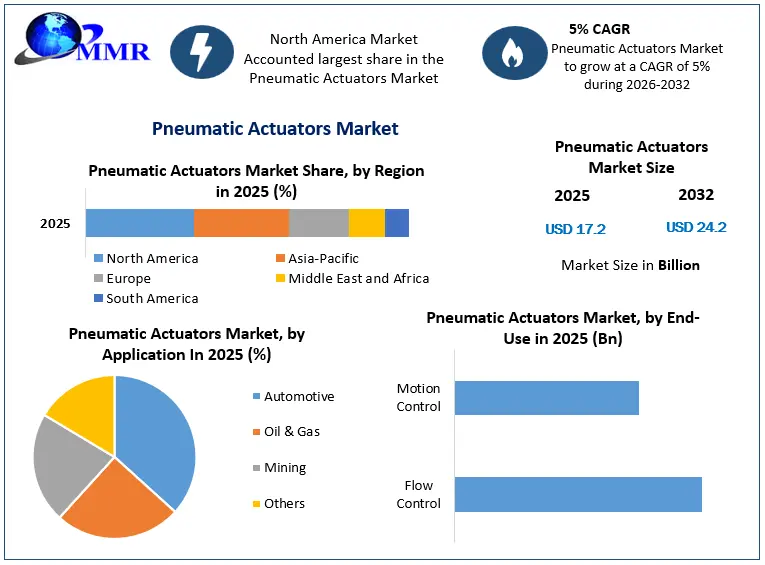
- Global Pneumatic Actuators Market valued at USD 17.2 billion in 2025
- Market expected to reach USD 24.2 billion by 2032
- Forecast CAGR stands at 5% during 2026–2032
- Automation investments remain the primary growth catalyst
- Automotive manufacturing continues expanding actuator deployment across production processes
- Smart factory initiatives increase demand for reliable motion-control systems
- Asia-Pacific strengthens its position as a key manufacturing hub
- Competitive focus shifts toward technology enhancement, operational efficiency, and application-specific solutions
Why This Matters Now
Automotive manufacturers are under pressure to increase production efficiency while managing cost volatility and stricter quality requirements. Every incremental improvement in factory automation directly affects margins, throughput, and competitive positioning.
Pneumatic actuators have become a critical component of this transformation. As OEMs and Tier-1 suppliers modernize assembly operations and pursue smarter manufacturing strategies, demand for dependable and cost-effective actuation systems is rising. The result is a market expected to expand from USD 17.2 billion in 2025 to nearly USD 24.2 billion by 2032.
Market Overview
The global Pneumatic Actuators Market was valued at USD 17.2 billion in 2025. According to Maximize Market Research, market revenue is projected to grow at a CAGR of 5% between 2026 and 2032, reaching nearly USD 24.2 billion by the end of the forecast period.
For automotive and transportation stakeholders, this growth signals a broader shift toward industrial digitization and production optimization. Pneumatic actuators continue to offer advantages in speed, reliability, simplicity, and operating costs, making them attractive across automated manufacturing environments.
The market’s momentum is closely tied to global industrial investment cycles. Manufacturers increasingly seek technologies that improve productivity while reducing operational complexity. Pneumatic systems fit that requirement, particularly in applications where rapid motion and repeatability are essential.
The industry is also benefiting from wider adoption of automation technologies across vehicle assembly, component manufacturing, testing systems, and material-handling operations. As production facilities become more connected and data-driven, actuator systems are being integrated into increasingly sophisticated manufacturing architectures.
Key Trends Driving Growth
Automation remains the dominant growth engine. Manufacturers across automotive, industrial machinery, and process industries are expanding automation investments to improve productivity and operational consistency. Pneumatic actuators remain a preferred solution for many applications because they deliver fast response times while maintaining relatively low operating costs.
The transition toward smart factories is creating additional demand. Connected production environments require reliable motion-control systems capable of supporting automated workflows. Pneumatic actuators are increasingly deployed in assembly, handling, positioning, and process-control applications.
Automotive manufacturing presents a particularly important opportunity. Vehicle producers continue modernizing production lines to support higher efficiency, improved quality control, and flexible manufacturing capabilities. Pneumatic actuators are widely used throughout assembly operations, testing systems, and automated production equipment.
Another significant trend is the growing emphasis on operational resilience. Manufacturers are prioritizing technologies that reduce downtime and simplify maintenance requirements. Pneumatic systems often offer advantages in durability and serviceability, supporting broader adoption across industrial facilities.
Investment in advanced manufacturing infrastructure is also reshaping competitive dynamics. Companies expanding production capacity increasingly incorporate automation from the outset, creating sustained demand for actuator technologies.
Need more information? Inquire about a sample report now
Segment Insights
- Dominant Segment: Motion-based actuator applications continue to represent a major share of market demand, supported by extensive deployment across industrial automation and manufacturing environments.
- Fastest-Growing Segment: Automation-intensive applications are expected to experience accelerated growth as manufacturers increase investments in productivity-enhancing technologies and smart factory infrastructure.
- Automotive manufacturing remains an important end-use area due to rising automation requirements in assembly and quality-control processes.
- Industrial process automation continues expanding actuator adoption across manufacturing, material handling, and operational control systems.
Regional Growth Story
Asia-Pacific continues to strengthen its position within the global manufacturing ecosystem. The region benefits from extensive industrial expansion, large-scale production capacity, and ongoing investment in automation technologies.
China remains a major force due to its manufacturing scale and continued industrial modernization. Investments in advanced production facilities support sustained demand for automation equipment, including pneumatic actuators.
India is emerging as an increasingly important market as manufacturing expansion, industrial policy initiatives, and infrastructure development encourage automation adoption. Automotive production growth further strengthens demand prospects.
Japan and South Korea continue emphasizing advanced manufacturing technologies, robotics, and precision production systems. Their focus on operational efficiency supports ongoing actuator deployment across industrial applications.
In Europe, Germany remains a strategic market because of its strong automotive and industrial manufacturing base. Investments in Industry 4.0 initiatives continue driving modernization efforts across production facilities.
The United States maintains robust demand through advanced manufacturing investments, factory upgrades, and productivity-focused automation strategies. Industrial modernization remains a key driver for actuator adoption.
Competitive Landscape
Competition is increasingly centered on technology differentiation, operational reliability, and application specialization.
Manufacturers are focusing on expanding product portfolios to address evolving automation requirements. Companies that can deliver higher efficiency, improved durability, and seamless integration into modern production systems are gaining competitive advantages.
Capacity expansion initiatives signal confidence in long-term automation demand. These investments are designed not only to increase production output but also to strengthen supply-chain responsiveness and customer support capabilities.
Strategic partnerships and product development efforts increasingly target advanced manufacturing environments. The objective is clear: become embedded within next-generation production ecosystems before competitors establish dominant positions.
The competitive landscape is also shaped by growing customer demand for customized solutions. Suppliers capable of addressing specific operational requirements are positioned to capture greater value as automation adoption expands.
Recent Developments
- Manufacturers continue investing in automation-focused product development.
- Smart manufacturing adoption is increasing actuator deployment across industrial facilities.
- Automotive production modernization programs are creating new demand opportunities.
- Industrial operators are prioritizing technologies that reduce downtime and improve productivity.
- Capacity expansion initiatives across manufacturing sectors support long-term market growth.
Strategic Implications
For OEMs, the market’s expansion highlights the importance of automation readiness. Companies that accelerate manufacturing modernization can improve productivity, quality consistency, and operational flexibility.
Tier-1 suppliers face a similar challenge. As vehicle production systems become increasingly automated, suppliers must align their manufacturing capabilities with evolving OEM requirements.
Investors should view the market as a broader indicator of industrial automation spending. Growth in pneumatic actuators closely tracks modernization trends across manufacturing sectors.
For policymakers, rising automation adoption reinforces the importance of workforce development, industrial infrastructure investment, and advanced manufacturing initiatives that strengthen competitiveness.
Future Outlook
The Pneumatic Actuators Market is entering a phase defined by automation, smart manufacturing, and industrial efficiency. As manufacturers pursue productivity gains and operational resilience, demand for reliable actuation technologies will continue rising. Companies that align with automation-driven production strategies will lead the next growth cycle, while those slow to modernize risk losing relevance in increasingly digital manufacturing environments.
The future leaders will be the companies that combine automation expertise, manufacturing scale, and technology innovation faster than their competitors.
Analyst Perspective
“The Pneumatic Actuators Market is moving beyond traditional industrial applications toward a broader role in automated manufacturing ecosystems. Organizations that invest early in automation-enabling technologies will be best positioned to capture growth opportunities as industrial modernization accelerates worldwide.” — Dharati Raut, Analyst
About Maximize Market Research
Maximize Market Research Pvt. Ltd. (MMR) is a global market research and consulting company that provides reliable, data-focused, and practical business insights. The firm serves a wide range of industries, including healthcare, pharmaceuticals, technology, automotive, electronics, chemicals, personal care, and consumer goods. Through market forecasts, competitive analysis, strategic consulting, and industry impact assessments, MMR helps organizations understand changing market conditions, identify growth opportunities, and make informed business decisions for long-term success.
Contact Us
2nd Floor, Navale IT Park Phase 3
Pune Banglore Highway, Narhe
Pune, Maharashtra 411041, India
+91 9607365656
sales@maximizemarketresearch.com




Leave a Reply