
Key Highlights
-
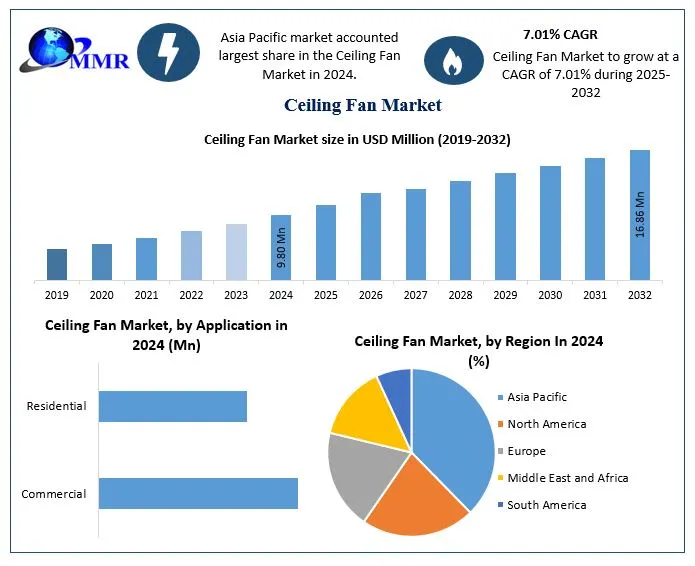
Market Capitalization Growth: The industry valuation rises from USD 9.80 million in 2024 to USD 16.86 million by 2032, securing an annualized 7.01% compound growth rate.
-
Product Form Dominance: Standard fans hold the largest share of the global market due to cost efficiency, straightforward design parameters, and high-volume deployment across residential pipelines.
-
Application Sector Leadership: The residential segment leads global demand, fueled directly by growing middle-class affordability and fast-moving population expansion.
-
Geographic Volume Base: The Asia-Pacific region secured the highest market share in 2024, maintaining structural dominance in both regional component assembly and end-user adoption.
-
Technological Architecture Transition: High consumer preference for smart technologies is driving original equipment manufacturers (OEMs) to accelerate the design of app-controlled and sensor-integrated home appliances.
Why This Matters Now
Electronics manufacturing services (EMS) firms, semiconductor foundries, and smart consumer appliance OEMs must immediately adjust their production lines to support intelligent component integration. Traditional mechanical ceiling fans are rapidly being phased out as global energy-efficiency mandates and smart-device ecosystems transform the consumer hardware industry.
Appliance brands can no longer rely on low-cost, basic induction motors to capture market share in developing urban centers. Companies that fail to deploy advanced motor-control microcontrollers, wireless connectivity chipsets, and edge-computing sensors directly into their product architectures will lose access to premium residential projects and automated smart-home distribution channels.
Market Overview
The global Ceiling fan market is transitioning from a basic electrical hardware segment into a highly technical, digitally connected branch of the consumer electronics industry. Valued at USD 9.80 million in 2024, this sector is projected to reach USD 16.86 million by 2032, maintaining a 7.01% compound annual growth rate. This structural growth marks a permanent change in how residential climate appliances are built, distributed, and managed across smart energy grids.
This market transformation is heavily driven by changing consumer lifestyles, warm climate conditions, and an increasing preference for next-generation automated technologies. Modern ceiling fans operate as active nodes within larger smart-home systems, using embedded electronic modules to communicate directly with mobile applications, environmental sensors, and home automation hubs. Consequently, component suppliers are optimizing their fabrication capacities to meet a surging global demand for low-cost, high-reliability logic and power semiconductors.
Key Trends Driving Growth
The increasing integration of IoT electronics and wireless chipsets into consumer appliances serves as a primary driver boosting global production volumes. Modern smart fans require dedicated microcontrollers to manage complex features like voice-activated control, variable speed scheduling, and automated temperature tracking. This shift creates a steady growth vector for semiconductor foundries specializing in consumer electronics, as every smart fan relies on embedded logic gates and memory modules to process environmental data at the network edge.
Concurrently, a broad structural shift toward energy-efficient motor technology alters traditional components manufacturing. Global regulatory mandates targeting carbon emissions and household power consumption are driving the adoption of brushless DC (BLDC) motors, which require specialized power management semiconductors and advanced motor-driver chips to function. This transition significantly changes the component bills of materials (BOM), shifting spending away from simple copper coils toward active silicon architectures that lower electricity consumption and improve product lifecycles.
Segment Insights
-
Standard Fans (Dominant Product Segment): This product type holds the largest share of the global marketplace. Standard fans remain the volume anchor for global factories because of their exceptional cost efficiency, easy maintenance profiles, and strong, consistent demand from rural and emerging residential regions.
-
Residential Application (Dominant Application Segment): This application vertical is expected to lead global market growth throughout the forecast timeline. Rapid population expansion combined with the growing affordability of the global middle class ensures steady volume requirements for domestic building installations.
-
Smart Fans (Fastest-Growing Product Segment): Driven by changing user preferences, this technical classification is growing rapidly as consumers seek out devices that easily connect with wider home automation networks.
Regional Growth Story
The Asia-Pacific region held the highest market share in 2024 and maintains absolute structural dominance over global manufacturing and sales networks. Rising industrialization across developing nations like India and China, alongside major residential building projects, provides a massive base of active consumer demand. This regional growth is further supported by expanding local component foundries and EMS ecosystems, allowing regional OEMs to source silicon parts quickly and mitigate international supply chain delays.
At the same time, mature markets across North America and Europe are experiencing a parallel shift toward highly technical smart fan variants, driven by an advanced home automation culture and rigid regional energy-efficiency guidelines. In these regions, manufacturers focus heavily on premium product designs that feature integrated LED display systems and advanced wireless connectivity. Meanwhile, emerging areas across Latin America, the Middle East, and Africa are experiencing steady volume expansion as investments in regional power grids and urban infrastructure lower the barriers to modern home appliance adoption.
Competitive Landscape
The global ceiling fan market features an intense mix of prominent multinational electronics corporations, regional appliance brands, and specialized smart-hardware startups. Key industry players include Usha, Havells India, SMC, ACC, Midea, Minka, Monte Carlo, Craftmade, Litex, Mountain Air, Hunter Fan Company, Casablanca, Emerson Ceiling Fans, Fanimation, Kichler, Panasonic, Crompton Greaves, and Orient Fans. Market leverage belongs to companies that can maintain automated production lines while securing long-term semiconductor supply contracts for advanced motor-control silicon.
To defend their market positions, top-tier appliance brands are pursuing vertical engineering alliances, working closely with semiconductor design firms to create custom, low-cost integrated circuits (ICs) for BLDC motor control. These targeted R&D initiatives help manufacturers reduce overall component count, simplify circuit board assembly, and protect operating margins against volatile raw material prices. Furthermore, launching comprehensive digital marketing campaigns alongside virtual trade exhibitions allows leading brands to expand their global distribution networks and reach new consumer segments directly.
Recent Developments
-
Modern appliance developers have expanded manufacturing lines for smart, app-controlled ceiling fans that easily pair with automated home hubs and voice-activation software.
-
Top-tier component providers have introduced low-profile motor-driver ICs designed specifically to fit into compact fan housings without reducing torque output.
-
Leading international consumer brands have updated their product catalogs with highly efficient BLDC fan models that comply with new, strict government energy star ratings.
-
Regional manufacturing facilities have deployed advanced electronic assembly systems to automate circuit board production for high-volume consumer appliance lines.
Strategic Implications
The integration of high-reliability silicon components with legacy mechanical home appliances introduces unique technical and financial considerations for engineering teams. Unlike simple mechanical fans, smart appliances require steady microchip sourcing, which exposes manufacturers to the supply chain variables and capacity limitations of global semiconductor foundries. Appliance brands must build diversified supply chains and form strategic partnerships with chip distributors to secure steady component volumes and prevent factory line stoppages.
Furthermore, introducing active electronic modules into high-volume home appliances requires robust data security measures and regular firmware update networks. As ceiling fans convert into active data nodes that monitor local home environments, manufacturers must invest in secure hardware layouts to protect user privacy and prevent unauthorized network access. OEMs that successfully master high-volume electronic component sourcing while delivering highly efficient smart products will secure superior market positions and improve brand equity across automated distribution channels.
Future Outlook
Global appliance manufacturing will increasingly reward agile corporations that successfully integrate high-efficiency motor controllers, wireless connectivity chipsets, and automated edge-computing sensors on a unified production platform. As global middle-class populations grow and zero-emission building codes tighten across urban centers, the demand for high-efficiency mechanical designs paired with smart home networks will accelerate.
The future marketplace will be strictly divided between innovative electronics leaders who build interoperable, smart-appliance ecosystems and agile component networks, and legacy hardware assemblers who fail to modernize their core product lines.
Analyst Perspective
“The global ceiling fan market is undergoing an important technology transition as simple electric cooling hardware evolves into an intelligent, connected home appliance asset,” stated Rucha Deshpande, Lead Analyst at Maximize Market Research.
About Maximize Market Research
Maximize Market Research Pvt. Ltd. (MMR) is a global market research and consulting company that provides reliable, data-focused, and practical business insights. The firm serves a wide range of industries, including healthcare, pharmaceuticals, technology, automotive, electronics, chemicals, personal care, and consumer goods. Through market forecasts, competitive analysis, strategic consulting, and industry impact assessments, MMR helps organizations understand changing market conditions, identify growth opportunities, and make informed business decisions for long-term success.
2nd Floor, Navale IT Park Phase 3
Pune Banglore Highway, Narhe
Pune, Maharashtra 411041, India
+91 9607365656
sales@maximizemarketresearch.com







Leave a Reply