
Key Highlights
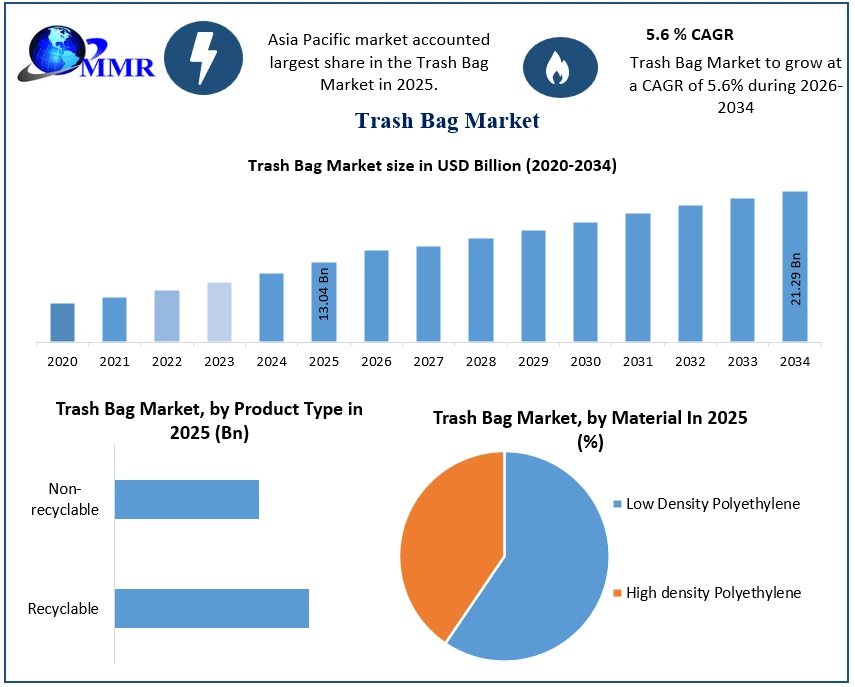
- The Trash Bags Market was valued at USD 13.04 Bn in 2025 and is expected to reach USD 21.29 Bn by 2034, giving waste-packaging suppliers a larger demand pool across homes, offices, healthcare facilities and commercial sites.
- The market is forecast to grow at a 5.6% CAGR from 2026 to 2034, driven by waste generation, sanitation awareness, urbanization and odor-control demand.
- Recyclable bags dominated with 57.47% share in 2025, making biodegradable and resource-saving formats the leading product segment.
- Residential users held 65.39% share in 2025, showing that household food waste, odor control and cleanliness remain the largest end-use demand base.
- Asia Pacific dominated with 52% share in 2025, supported by high population density, China’s production base and India’s rising waste-management burden.
Why This Matters Now
Trash bags are becoming a regulatory and materials decision, not a commodity replenishment item. FMCG buyers, retailers and municipal operators now need liners that manage odor, meet waste rules and reduce exposure to plastic-policy pressure.
The Trash Bags Market move from USD 13.04 Bn in 2025 to USD 21.29 Bn by 2034 creates volume growth, but the margin story will be decided by polyethylene supply, recyclable formats and biodegradable alternatives.
Market Overview
Trash bags are plastic bags placed inside bins to hold waste and keep containers clean. They are also sold as rubbish bags, garbage bags and bin liners, with white, blue, red and black variants used across healthcare facilities, bathrooms, offices and kitchens.
Most trash bags are made from polythene with different densities. The market is segmented by material into low-density polyethylene and high-density polyethylene, by product into recyclable and non-recyclable bags, and by end user into residential and commercial segments.
The category’s commercial function is simple but critical. Trash bags support affordable waste disposal, reduce toxicity, aid sanitation in hospitals and control odor from waste.
Key Trends Driving Growth
Waste generation is the core driver. MMR cites a World Bank figure that the world generates 2.01 Bn tonnes of solid waste annually, which means collection, containment and disposal products will remain essential to urban and commercial hygiene systems.
Healthcare waste adds urgency. The report cites the World Health Organization’s estimate that 15% of hospital waste is infectious, creating demand for liners that support safer sanitation and reduce contamination risks in institutional environments.
Household income, urbanization and economic development are expanding daily-use demand. As more consumers prioritize hygiene and sanitation, odor-blocking capacity becomes a product feature that can support premiumization in an otherwise price-sensitive market.
Regulation is shifting material choices. India’s Plastic Waste Management Amendment Rules increased carrying-bag thickness from 50 microns to 75 microns, creating a compliance-driven advantage for manufacturers able to supply stronger bags.
Sustainability pressure is also changing innovation. MMR cites wood-based trash bags from VTT Technical Research Centre of Finland and compostable coatings using silicate and biopolymers from the Fraunhofer Institute for Silicate Research, signaling movement beyond conventional plastic liners.
Download a Premium Market Research Sample for Free
Segment Insights
- Dominant Segment Recyclable Bags: Recyclable bags held 57.47% share in 2025. MMR identifies them as biodegradable, durable, environment-friendly and resource-saving, giving suppliers a stronger position as buyers move away from landfill-heavy waste formats.
- Dominant Material Segment Low-Density Polyethylene: LDPE dominates by material type because of chemical resistance, softness, non-contaminating properties and non-toxic nature. The page lists a segment value that conflicts with the total market size, so that value is omitted.
- Dominant End-User Segment Residential: Residential users held 65.39% share in 2025. Rising disposal of food waste, odor-control needs and stronger consumer interest in cleanliness make homes the largest demand base.
- Fastest-Growing Segment: The public page does not label any segment as fastest-growing. It discloses CAGRs of 4.5% for recyclable bags, 3.8% for residential use and 3.5% for LDPE, but does not identify an official fastest-growing segment.
- Health and Sustainability Signal: Clean-label demand is not disclosed. Sustainability appears through recyclable bags, biodegradable positioning, wood-based bags, compostable coatings and PLA cost parity.
Regional Growth Story
Asia Pacific dominated with 52% share in 2025. The region benefits from highly populated markets such as China and India, rising urbanization, economic expansion, hygiene awareness and environmental-safety focus.
India is a major future pressure point. The report states that India’s waste generation is expected to reach 387.8 Mn tonnes by 2034, creating a long-term demand base for trash bags, municipal liners and household waste-containment products.
China is critical on supply. MMR states that China accounts for 29% of global trash bag production, while its effort to reduce single-use plastic and recycle 35% of generated waste is reshaping production and product strategy.
North America is the second-dominating region. The U.S. generated 298.2 Mn tons of waste in the cited year, and Federal Trade Commission guidance on biodegradable bags makes environmental claims a compliance issue as well as a marketing claim.
Competitive Landscape
Key players include Pack-It B.V., Kemii Garbage Bag Co. Ltd., Cosmoplast Industrial Company, Luban Packing, Hefty, International Plastics, Novolex, Novplasta, Terdex, Berry Global, The Clorox Company, Reynolds Consumer Products, Inteplast Group and Four Star Plastics.
Competition is built around material access, odor control, brand visibility, retail reach and regulatory readiness. LDPE and HDPE suppliers must now compete against recyclable, biodegradable and PLA-based alternatives, which can alter pricing power if bio-based costs remain competitive.
Reynolds Consumer Products’ Hefty launch shows that established brands are using scent, color and odor-neutralizing technology to defend shelf space. That signals a shift from plain liners toward branded household-care products with sensory differentiation.
NatureWorks’ PLA cost-parity milestone is more disruptive. A 75,000-ton facility in Thailand and a commercial price of about USD 1.52 per kilogram reduce the historic price barrier for biodegradable trash bags, which may pressure conventional LLDPE and LDPE suppliers over the next 12–24 months.
Recent Developments
- 14 April 2026 Reynolds Consumer Products: The company launched Hefty Ultra Strong Peach Fabuloso Scented Trash Bags, expanding its Color Series and targeting demand for visual variety and odor-neutralizing features.
- 03 June 2026 Town of Westford, Massachusetts: Local businesses partnered with the municipality to supply Pay-As-You-Throw overflow bags with mandatory 30-pound capacity, using bags as a regulatory lever for waste reduction.
- 04 June 2026 Japan Petrochemical Industry Association: A 62% decline in polyethylene production for garbage and shopping bags created a regional bottleneck, pushing supermarkets to reduce single-item plastic wrapping and consider alternative liner options.
- 15 November 2025 NatureWorks LLC: The firm achieved feedstock cost parity with conventional LLDPE and LDPE after its 75,000-ton PLA plant in Thailand became fully operational.
Strategic Implications
For manufacturers, material strategy is now the key boardroom issue. Polyethylene remains the base material, but recyclable bags, PLA pricing and compostable coatings are changing procurement risk and product development priorities.
For retailers, trash bags offer more than utility. Scented, colored and odor-control variants can increase household-care basket value, while recyclable formats can answer consumer concern about landfill and plastic waste.
For municipalities and institutional buyers, bags can shape behavior. Pay-As-You-Throw overflow bags show how regulated bag formats can support waste-volume reduction and collection efficiency.
Future Outlook
The Trash Bags Market is forecast to grow from USD 13.04 Bn in 2025 to USD 21.29 Bn by 2034 at a 5.6% CAGR. Growth will come from waste generation, hygiene awareness, residential food-waste disposal, recyclable bag adoption, Asia Pacific demand and material innovation.
The public page does not disclose e-commerce penetration, country-level revenue values, detailed pricing trends beyond PLA cost parity, or named M&A transactions. That limits the visible outlook to market size, segment shares, regional leadership and disclosed industry developments.
Winners will combine reliable polyethylene supply, recyclable product depth and biodegradable cost competitiveness; losers will be exposed to plastic-policy pressure, feedstock bottlenecks and weak odor-control differentiation.
Analyst Perspective
“Trash bags are moving from basic waste liners to regulated, branded and sustainability-sensitive household products,” said Siddhi Dole, Analyst at Maximize Market Research. “The strongest suppliers will combine LDPE performance, recyclable formats, odor-control innovation and material flexibility as biodegradable alternatives reach cost parity.”
About Maximize Market Research
Maximize Market Research Pvt. Ltd. (MMR) is a global market research and consulting company that provides reliable, data-focused, and practical business insights. The firm serves a wide range of industries, including healthcare, pharmaceuticals, technology, automotive, electronics, chemicals, personal care, and consumer goods. Through market forecasts, competitive analysis, strategic consulting, and industry impact assessments, MMR helps organizations understand changing market conditions, identify growth opportunities, and make informed business decisions for long-term success.
Contact Us
2nd Floor, Navale IT Park Phase 3
Pune Banglore Highway, Narhe
Pune, Maharashtra 411041, India
+91 9607365656
sales@maximizemarketresearch.com


.webp "Asset Tracking Market to Reach USD 47.69 Billion by 2032")




Leave a Reply