
Key Highlights
-
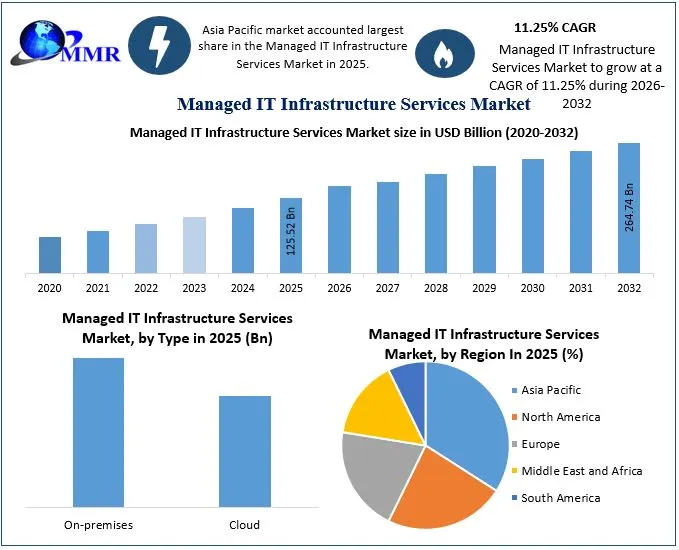
The global market reached USD 125.52 billion in 2025 and is scaling toward USD 264.74 billion by 2032.
-
A robust compound annual growth rate (CAGR) of 11.25% fuels the seven-year forecast period.
-
Asia-Pacific maintains its structural dominance, anchored by heavy automotive and electronics manufacturing investments.
-
The IT and Telecommunications end-user segment commands the largest market share, while Manufacturing emerges as a primary growth accelerator.
-
Outsourcing mission-critical architecture resolves persistent skilled labor shortages and mitigates costly factory downtime.
-
Integration of robotics, automated systems, and connected operational technology (OT) exposes factories to heightened reliability and cybersecurity requirements.
Why This Matters Now
The convergence of operational technology and corporate IT networks has transformed the modern factory floor into an data-heavy environment. Manufacturers no longer view IT infrastructure as a back-office utility, but as the foundational engine of industrial automation. As legacy hardware becomes obsolete and the cost of unexpected downtime escalates, industrial operators are pivoting away from self-managed setups. They are shifting instead toward specialized external providers to secure, optimize, and maintain their underlying digital frameworks.
What changed? Historically, factory floors operated on isolated, air-gapped systems that required minimal external IT intervention. Today, the rise of connected machinery, cloud-based manufacturing execution systems (MES), and real-time data streaming demands continuous network availability and high-level cybersecurity protection.
Why now? Industrial operators face acute shortages of internal technical talent capable of bridging the gap between legacy programmable logic controllers (PLCs) and cloud analytics. By transitioning to a managed service framework, plants insulate themselves against system failures, offload the burden of routine hardware lifecycle updates, and reallocate internal engineering resources toward direct production optimization.
Market Overview
The global Managed IT Infrastructure Services Market Size reached a valuation of USD 125.52 billion in 2025. Driven by an accelerating need for operational resilience, the market is projected to expand at an 11.25% CAGR, hitting USD 264.74 billion by 2032. This sustained capital expansion underscores a systemic shift across global supply chains to replace outdated, fragmented computing hardware with flexible, managed infrastructure environments.
The financial rationale for this transition is clear. Industrial networks must support vast arrays of data generated by supervisory control and data acquisition (SCADA) systems, distributed control systems (DCS), and industrial IoT (IIoT) sensors. Maintaining these architectures internally introduces substantial overhead and overhead volatility. Managed services stabilize these operational expenditures by turning capital investments into predictable, monthly operating costs. This shift gives organizations the fiscal elasticity to fund targeted physical automation upgrades.
Key Trends Driving Growth
The rapid adoption of robotics and advanced industrial automation stands as a premier catalyst for managed services growth. As automotive assembly plants and electronics facilities deploy autonomous mobile robots (AMRs) and automated guided vehicles (AGVs), the sheer volume of localized network traffic increases exponentially. This surge requires robust local network management and edge-computing frameworks to prevent latency, which could otherwise stall active production lines or trigger machinery collisions.
Simultaneously, the industry-wide push to lower human labor dependencies and eliminate manual errors requires highly resilient software environments. Predictive maintenance systems, which rely on continuous machine-learning assessments of equipment acoustics, heat, and vibration, depend completely on uninterrupted data pipelines. If a network drops, the data stream breaks, rendering predictive models blind to imminent component failures. Managed infrastructure providers guarantee the network availability and security parameters required to keep these AI-driven predictive systems operational around the clock.
Segment Insights
-
IT and Telecommunications (Dominant Segment): Holding the largest share of the market in 2025, this segment remains the bedrock of managed services demand due to its massive data throughput and complex network requirements.
-
Manufacturing, BFSI, and Healthcare (Fastest-Growing Segment): These sectors are rapidly scaling their infrastructure investments. Within this cohort, manufacturing exhibits explosive demand as traditional factories transition into highly connected smart factories.
-
Large Enterprises versus SMEs: Large industrial groups utilize managed services to standardize infrastructure across multi-plant portfolios, while small-to-medium enterprises rely on providers to gain enterprise-grade technical capabilities without maintaining an expensive in-house IT department.
Regional Growth Story
The Asia-Pacific region dominated global market share in 2025 and is positioned to maintain its leading position through 2032. This dominance is directly tied to massive manufacturing investments, structural factory digitization initiatives, and aggressive smart factory rollouts across China, Japan, India, and South Korea. These nations host dense clusters of automotive production, semiconductor fabrication, and heavy industrial machinery manufacturing, all of which require highly secure and stable IT environments to protect intellectual property and ensure operational uptime.
In North America and Europe, growth is propelled by factory modernization and the need to replace obsolete legacy equipment. As industrial operators in the United States and Germany struggle with aging workforces and high operational costs, they rely heavily on managed IT infrastructure to maximize labor productivity. Furthermore, stringent industrial cybersecurity regulations in Western markets compel manufacturers to lean on tier-one managed service providers to achieve compliance across interconnected supply chain networks.
Competitive Landscape
The competitive environment features established technology giants, including Accenture Plc, Fujitsu Limited, Lenovo Group Limited, Cisco Systems Inc., Dell Technologies Inc., Happiest Minds Technologies, DXC Technology Corporation, and International Business Machines Corporation. The strategic moves of these market leaders signal an industry-wide pivot toward automated, intelligent infrastructure management. Rather than merely offering basic data storage or remote monitoring, these providers are packaging specialized solutions designed to bridge the historical divide between IT and operational technology environments.
This shift highlights a clear reality: technology leadership is no longer judged solely on compute power, but on how effectively a provider can eliminate operational friction for end users. Major players are embedding advanced AI and automation tools directly into their service suites to proactively resolve network bottlenecks before they affect the factory floor. For industrial operators, selecting a provider has evolved into a strategic alignment with partners who can actively protect production uptime, optimize data pipelines, and support complex smart manufacturing applications.
Recent Developments
-
Tier-one providers are introducing AI-driven diagnostic tools within their managed services suites to identify and resolve network vulnerabilities before they impact manufacturing operations execution systems.
-
Service providers are expanding their edge-computing management capabilities to support localized data processing for high-speed machine vision and real-time robotic controls.
-
Industry leaders are forming targeted alliances with industrial automation OEMs to create standardized, secure interfaces that simplify the connection of legacy shop-floor machines to managed cloud databases.
Strategic Implications
For manufacturing executives and plant managers, the expansion of the managed IT infrastructure services market alters the competitive landscape. Organizations that continue to rely on siloed, internally managed IT setups risk falling behind due to slow deployment times, recurring security challenges, and high overhead costs. Conversely, companies that embrace external managed services gain immediate access to enterprise-grade security, rapid scalability, and optimized system performance.
Who benefits most? Operations leaders and system integrators stand to gain significantly. By offloading infrastructure management to external experts, system integrators can focus entirely on designing and tuning process control applications, rather than troubleshooting underlying network problems. Plant managers gain clear visibility into operational costs and data-driven performance metrics, allowing them to make fast, strategic adjustments that improve overall equipment effectiveness (OEE).
Future Outlook
What happens next? The market is moving toward autonomous industrial operations where the lines between IT infrastructure and factory automation disappear entirely. Over the next decade, managed infrastructure services will become the vital foundation for digital twin deployments, closed-loop AI operations, and synchronized multi-plant automation ecosystems. The resulting shift will clearly separate market leaders from laggards: forward-thinking manufacturers will leverage managed IT infrastructure to build agile, resilient smart factories, while slow-moving operators will struggle with high overhead, frequent downtime, and outdated, vulnerable networks.
Analyst Perspective
“The modern manufacturing environment demands absolute synchronization between shop-floor machines and enterprise databases,” says Yash Ghosalkar, Research Analyst at Maximize Market Research. “By adopting managed IT infrastructure services, industrial operators can confidently transition away from costly, reactive maintenance models and embrace fully optimized, secure, and predictive smart manufacturing operations.”
About Maximize Market Research
Maximize Market Research Pvt. Ltd. (MMR) is a global market research and consulting company that provides reliable, data-focused, and practical business insights. The firm serves a wide range of industries, including healthcare, pharmaceuticals, technology, automotive, electronics, chemicals, personal care, and consumer goods. Through market forecasts, competitive analysis, strategic consulting, and industry impact assessments, MMR helps organizations understand changing market conditions, identify growth opportunities, and make informed business decisions for long-term success.
2nd Floor, Navale IT Park Phase 3
Pune Banglore Highway, Narhe
Pune, Maharashtra 411041, India
+91 9607365656
sales@maximizemarketresearch.com






Leave a Reply