
Key Highlights
-
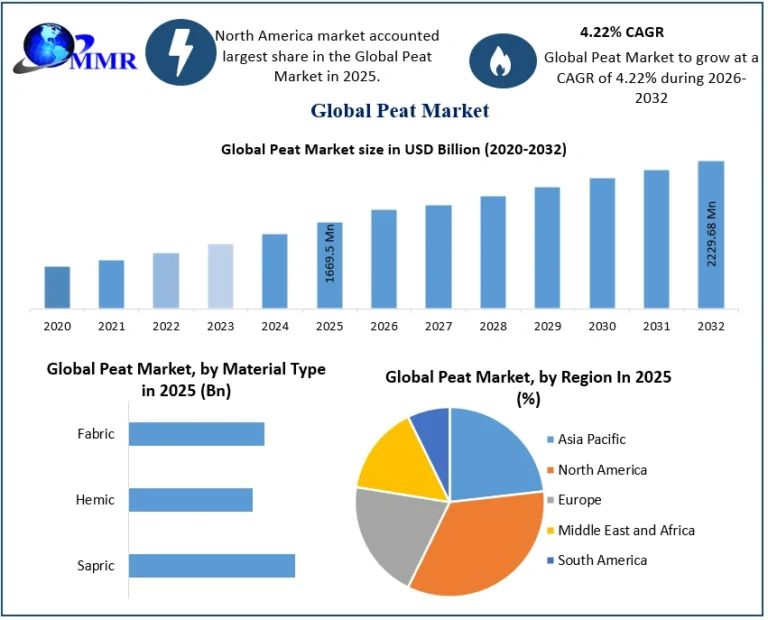
Global Market Scale and Valuation: The Global Peat Market was valued at USD 1.67 Billion in 2025.
-
Forward Projection: Anticipated to reach approximately USD 2.23 Billion by 2032, expanding at a steady compound annual growth rate (CAGR) of 4.22% from 2025 to 2032.
-
Dominant Type Segment: The Coco Peat segment captures the top position in the market, holding a dominant 44.5% revenue share due to its excellent aeration, lower environmental footprint, and high reuse lifecycle.
-
Leading Material Class: The Hemic peat segment dominates by decomposition type, securing roughly 40.4% of market share as it balances functional fibrous structural traits with substantial humic content.
-
Primary Regional Locomotive: North America maintains absolute global market leadership, commanding a valuation of USD 645.13 Million in 2025, heavily propelled by massive commercial greenhouse pipelines across Canada and the U.S.
Why This Matters Now
The yield predictability of commercial food networks and specialized ornamental nurseries depends directly on isolating crops from sub-optimal, degraded field soils. As modern farming operations face rapid soil erosion and aggressive chemical restrictions, traditional topsoil treatments are falling short of expected baseline production metrics. Agribusiness operators, structural investors, and landscaping planners are recognizing that uncontrolled soil moisture swings lead to significant crop failures or quality degradation. Implementing highly stable, premium organic substrates has evolved from a simple cultivation preference into an essential strategic safeguard to optimize water efficiency and protect delicate root zones under unpredictable climate shifts.
Market Overview
The peat market acts as an essential foundation for international food safety, commercial horticulture, and advanced forestry restoration ecosystems. Serving as a premier structural media for water retention and soil conditioning, peat arrays protect delicate root frameworks from drying out and encourage uniform nutrient uptake. Valued at USD 1.67 Billion in 2025, the market’s projected trajectory toward USD 2.23 Billion by 2032 reflects an industry-wide transition toward precision organic blends and high-efficiency raw material extraction.
What changed is the primary baseline criteria for sourcing growing media. In earlier farming cycles, basic field soil or standard untreated moss was considered sufficient for seasonal seedlings. Today, the massive scale of modern automated greenhouses and vertical indoor farms requires specialized substrates characterized by balanced porosity, optimal pH buffering, and minimal weed seed contamination. This trend has created an opening for highly sustainable alternatives like coco peat (derived from upcycled coconut husks) to take a leading role in standard agricultural supply chains.
Key Trends Driving Growth
The core catalyst pushing market value forward is the rapid development of premium composite substrates that blend traditional peat with sustainable raw materials. Top-tier producers are increasingly engineering high-performance media that integrate coco peat, processed wood fibers, and organic compost. These composite configurations preserve high moisture-holding capabilities while satisfying strict carbon-neutral targets and corporate ESG requirements.
Another primary driver is the widespread implementation of automated harvesting and packaging technologies across primary excavation sites in North America and Northern Europe. Leading extraction firms are installing smart moisture-tracking packaging arrays and automated drying tunnels. These technological improvements optimize raw material weights, protect natural fiber lengths, and significantly lower global shipping overheads.
Furthermore, expanding structural soil degradation and strict crop quality standards across major economies are driving massive institutional investments in precision horticulture. Greenhouse developers are aggressively scaling seedling cultivation facilities that rely heavily on clean, peat-based plugs to maximize germination reliability. This trend drives long-term component procurement across global agrochemical and distribution networks.
Segment Insights
-
Coco Peat [Dominant Segment]: This upcycled product leads the market type landscape. Offering superior drainage metrics and an excellent natural life cycle alongside high sustainability ratings, it has rapidly become the preferred choice for professional hydroponics and commercial potting soil producers.
-
Hemic Peat [Dominant Material Type]: This material variant captures the highest market share among physical types. Representing a moderate level of organic plant decomposition, it provides an ideal combination of fiber structure and fluid retention, making it highly versatile for general crop cultivation and retail potting mixes.
-
Agriculture & Horticulture [Dominant End-Use]: This vertical represents the largest operational application area. Driven by massive commercial farming retrofits, strict food safety frameworks, and widespread urban landscaping activities, it maintains a continuous and highly predictable consumption profile.
Regional Growth Story
North America anchors the global peat market, backed by massive natural reserves across Canada and sophisticated commercial farming infrastructures in the United States. The region’s extensive reliance on advanced containerized forestry, industrial landscaping, and precision berry farming drives steady demand for high-grade soil conditioners. Strong trade partnerships between Canadian extraction operations and international agri-tech firms further solidify the continent’s dominant market share.
Concurrently, Europe remains a pivotal region for regulatory transformation and product innovation. Major producers in Germany, Latvia, Estonia, and the Netherlands are reshaping their supply chains to align with strict EU environmental directives and active peatland restoration initiatives. Meanwhile, Asia Pacific is emerging as the fastest-growing consumption hub, propelled by massive greenhouse seedling booms in China and heavy exports of coco peat from specialized processing operations in Sri Lanka and India.
Competitive Landscape
The competitive matrix of the global peat industry reveals a distinct trend toward vertical integration, sustainable resource branding, and strategic export realignments. Top-tier corporate suppliers and specialized material processors are actively expanding their processing capabilities to better align with changing global agricultural rules. This industrial shift means that low-tech, non-sustainable harvesting operations will face major market access barriers as commercial agribusiness developers direct their procurement toward verified, eco-certified brands.
Furthermore, upstream material technology and logistical reliability are becoming the main pillars of market success. Enterprises that own long-term supply agreements for clean coco coir or those utilizing advanced automated drying platforms can consistently offer predictable pricing profiles to their distributors. This reality is driving a wave of strategic joint ventures between established Western peat corporations, South Asian agricultural suppliers, and regional agri-tech investors to insulate pipelines against volatile shipping costs.
Recent Developments
-
Smart Moisture-Tracking Packaging Introduced (2025): Major North American horticulture companies roll out advanced consumer and industrial packaging equipped with integrated sensors to optimize substrate moisture consistency during long-distance transit.
-
International Agri-Tech Export Lines Secured (2025): Leading Canadian harvesting corporations finalize multi-year distribution agreements with prominent Saudi Arabian and Middle Eastern indoor farming collectives to secure baseline growing media lines.
-
Automated Processing Expansion Completed (2025): Prominent European operators install high-efficiency automated drying and screening equipment in Latvia, boosting output reliability while reducing operational emissions.
-
Renewable Blend Product Lines Launched (2025): Leading energy and substrate groups introduce eco-focused product lines across Germany, specifically targeting sustainable power and organic farming networks with low-emission alternatives.
Strategic Implications
For commercial growers and greenhouse operators, substrate selection directly dictates seasonal crop yield stability and overall resource overheads. Relying on inconsistent, low-spec media mixes introduces high risks of root rot, inconsistent nutrient delivery, and unpredictable drainage profiles. This volatility lowers operational efficiency, directly hurting agribusiness profits and institutional investors who require steady, uniform crop outputs to meet retail delivery deadlines.
For substrate processors and equipment vendors, strict ecological compliance is now a mandatory ticket to global markets. As major agricultural buyers enforce rigid sustainability scorecards, providers using uncertified extraction techniques or offering high-emission products will face exclusion from tier-one commercial contracts. Continuous investment in circular material formulations, advanced eco-certification, and efficient regional supply lines is required to protect global brand value.
Future Outlook
The evolution of the peat market will be shaped by its ability to balance traditional performance traits with low-carbon structural innovations. As global food networks move toward fully trace-mapped farming platforms and circular resource layouts, peat-based assets will increasingly shift toward smart, hybrid bio-mixtures rather than raw organic elements. Future market leadership will favor advanced substrate combinations that integrate beneficial microbes and slow-release nutrients into high-purity coco and hemic matrices. Ultimately, the industry will split along clear operational lines: progressive companies providing trace-verified, high-efficiency hybrid alternatives will achieve dominant market share, while laggards depending on unsustainable, unblended extraction processes will face marginalization as global agricultural systems embrace a carbon-conscious framework.
Analyst Perspective
“The global peat market has moved past the era of viewing growing media as a simple commodity item; it has shifted into a high-stakes conversation regarding global crop security and precision resource allocation,” explains an Analyst at Maximize Market Research. “As institutional greenhouse developers and urban farming complexes transition to highly optimized, automated cultivation designs, specialized alternative substrates and trace-verified hybrid blends represent the primary infrastructure anchor securing uniform yields and maximizing agricultural returns.”
About Maximize Market Research
Maximize Market Research is a high-growth market research and business consulting firm serving global clients with deeply quantified institutional insights across high-technology supply chains, energy systems, and advanced materials. For an exhaustive breakdown of localized data, structural segment forecasts, and granular competitive intelligence, the complete official study can be accessed via the verified source report: Global Peat Market.
2nd Floor, Navale IT Park Phase 3
Pune Bangalore Highway, Narhe
Pune, Maharashtra 411041, India
+91 9607365656




Leave a Reply