
Key Highlights
-
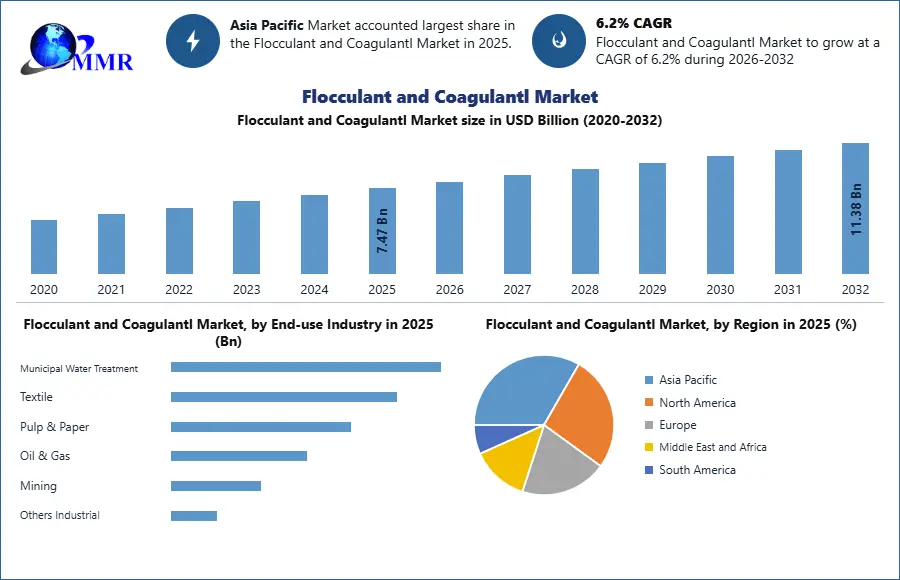
The global market reached a valuation of USD 7.47 billion in 2025 and is projected to expand to USD 11.38 billion by 2032.
-
The industry is expanding at a steady 6.2% compound annual growth rate over the 2026 to 2032 forecast horizon.
-
Inorganic coagulants represent the dominant technology sub-segment, acting as a structural cornerstone for major municipal processing systems.
-
Organic coagulants emerge as the fastest-growing sub-segment, driven by a corporate pivot toward reduced chemical sludge volumes.
-
The pulp & paper category holds one of the largest consuming end-use segments due to high fluid utilization rates during manufacturing.
-
Asia-Pacific retains absolute regional dominance, propelled by heavy industrial implementation throughout China, India, Japan, and Indonesia.
-
Tier-1 suppliers are consolidating infrastructure footprints to counteract fluctuating raw material pricing and safeguard logistics pipelines.
Why This Matters Now
Industrial chemical procurers, municipal plant managers, and environmental commodity investors face a tightening compliance landscape as liquid discharge limits reach historic stringency. Accelerating global water pollution and a widening awareness of clean drinking water access are forcing processing facilities to overhaul their primary chemical treatment infrastructures. Regulators are eliminating historical legal loopholes for industrial discharge, transforming wastewater treatment from a secondary compliance chore into a critical prerequisite for manufacturing survival.
What changed? The commercial baseline has shifted from basic commodity filtration toward specialized, high-yield molecular formulation. Why now? Rapidly expanding downstream manufacturing operations within emerging regions are consuming water assets at rates that outpace natural regeneration, creating a reliance on recycled process fluids. Companies that secure long-term allocations of specialized separation polymers insulate their plants from operational shutdowns, while laggards face compounding penalties and escalating clean-water procurement expenses.
Market Overview
The global flocculant and coagulant market achieved an aggregate valuation of USD 7.47 billion in 2025. Fueled by intensifying municipal remediation programs and deep downstream industrial integration, global revenue is projected to climb to USD 11.38 billion by 2032. This development reflects a 6.2% CAGR across the forecast timeline.
The baseline driver of this trajectory is the necessity of these substances within primary separation technologies globally. The proliferation of harmful waterborne diseases acts as a primary catalyst, forcing public and private managers to expand their treatment capacities. As a critical component of both potable clarification and industrial effluent dewatering, these chemical agents see consistent demand across both municipal and commercial frameworks.
Key Trends Driving Growth
Rising urbanization combined with extensive global manufacturing volumes is placing unprecedented pressure on municipal water treatment systems. This structural demand forces authorities to expand chemical processing infrastructure to meet safe drinking standards for expanding urban centers. Simultaneously, the manufacturing sector requires advanced purification technologies to fulfill internal reuse objectives and meet strict government regulations.
These dynamics are reshaping specialized feedstock requirements across key production hubs. The transition toward high-density manufacturing requires advanced solid-liquid separation to isolate complex particulate matter before discharge. Consequently, chemical manufacturers are shifting production lines toward tailored organic and polymeric agents, creating an integrated ecosystem where chemical design directly solves regional water scarcity challenges.
Segment Insights
-
Dominant Sub-segment: Inorganic coagulants constitute one of the major contributors to the market’s physical volume and revenue base. Their cost-effective pricing structure and reliability across high-volume municipal clarify networks ensure their position as the dominant foundational technology for primary water processing plants.
-
Fastest-Growing Sub-segment: Organic coagulants represent the fastest-growing sub-segment during the forecast window. This rapid expansion is driven by their lower dosing requirements and their capacity to minimize post-treatment sludge accumulation, which directly lowers downstream disposal expenses for industrial operators.
-
Dominant End-use Segment: The pulp & paper segment holds one of the largest shares of the global market. This dominance stems directly from the massive volumes of process water utilized within paper mills, where flocculant and coagulant formulations are essential for sheet formation, fiber retention, and primary raw water remediation.
Regional Growth Story
The Asia-Pacific territory commands the premier position in the global landscape, maintaining the highest market share in 2025. This geographical dominance is anchored by extensive, high-volume chemical consumption across China, India, Japan, and Indonesia. Rapidly expanding industrial zones within these nations require massive quantities of specialized polymers to manage heavy manufacturing effluents and safeguard public utility networks.
Meanwhile, Western economies are focusing on specialized chemical adjustments. Strict statutory oversight throughout Germany, the United Kingdom, and the United States forces a corporate transition away from basic commodity agents and toward advanced, low-sludge organic variants. This structural regulatory push ensures that while Asia-Pacific drives absolute volume demand, Western nations remain vital testing grounds for premium, high-efficiency separation chemistry.
Competitive Landscape
The competitive structure of the market is defined by intense consolidation among a select tier of global multi-nationals. Leading entities like SNF Floerger, BASF SE, Kemira OYJ, and Ecolab Inc. are actively managing their production capacities to maintain pricing leverage over volatile raw material inputs. Smaller regional chemical blenders are increasingly squeezed out by these major players due to the high capital costs required to develop advanced polymer formulations.
Market leaders are optimizing their global supply networks to improve capacity utilization and insulate operations against localized supply shocks. This consolidation increases barriers to entry, as downstream industrial buyers prioritize suppliers that can guarantee consistent volume delivery and technical field support. Consequently, dominant chemical manufacturers are using their scale to establish multi-year procurement partnerships with major municipal and industrial consumers.
Recent Developments
-
SNF Floerger expanded its specialized polyacrylamide production networks to guarantee supply security for industrial wastewater filtration systems across key manufacturing corridors.
-
BASF SE optimized its water treatment portfolio by introducing advanced polymeric flocculant formulations designed to improve solid-liquid separation efficiency in heavy industrial environments.
-
Kemira OYJ increased investment across its coagulant manufacturing centers to improve raw material capacity and fulfill tightening municipal water safety mandates in Europe.
-
Ecolab Inc. integrated digital monitoring infrastructure alongside its traditional chemical distribution, allowing real-time adjustments of flocculant dosages within industrial cooling towers.
-
Solenis LLC completed strategic operational expansions within its paper processing chemical division to capture expanding pulp & paper treatment opportunities in developing economic zones.
Strategic Implications
SNF Floerger’s targeted polyacrylamide capacity expansions show how major producers are acting to protect their market share against supply chain disruptions. By increasing localized production, the company strengthens its pricing power and provides industrial buyers with a reliable buffer against logistical disruptions. Similarly, BASF SE’s introduction of specialized high-efficiency polymers indicates an industry-wide pivot away from low-margin commodity products and toward high-margin specialty chemicals that reduce total operational costs for the end-user.
Concurrently, Kemira’s capital investments in its European coagulant centers show how major players are aligning their operations with strict regional regulatory changes. This proactive approach allows Tier-1 chemical suppliers to secure long-term municipal contracts as water utility groups seek out compliant supply chains. Meanwhile, Ecolab’s integration of digital monitoring with traditional chemical delivery demonstrates that future market leadership will depend on offering end-to-end process control, allowing industrial buyers to optimize chemical consumption rates.
Future Outlook
The evolution of the global flocculant and coagulant market will be driven by the balance between low-cost inorganic options and high-performance organic formulations. Manufacturing organizations that integrate automated chemical dosing alongside high-efficiency polymers will protect their operations from raw water volatility and avoid regulatory fines. Conversely, producers reliant on outdated, high-sludge chemical options will face rising operational costs and escalating waste disposal liabilities. Ultimate market success will belong to chemical innovators that deliver concentrated, low-dosage separation agents that satisfy both strict environmental mandates and corporate cost-reduction targets.
Analyst Perspective
“The modern water treatment landscape is forcing a profound transformation in how industrial operators view chemical auxiliary procurement,” states Ankita Kagawade, Research Analyst at Maximize Market Research. “Flocculants and coagulants are no longer viewed as simple utility chemicals; they are now strategic tools required to maintain continuous production during periods of increasing water scarcity. As municipal frameworks and industrial players across the Asia-Pacific region ramp up their environmental investments, demand for specialized organic formulations will accelerate, offering chemical manufacturers high-margin growth opportunities.”
About Maximize Market Research
Maximize Market Research Pvt. Ltd. (MMR) is a global market research and consulting company that provides reliable, data-focused, and practical business insights. The firm serves a wide range of industries, including healthcare, pharmaceuticals, technology, automotive, electronics, chemicals, personal care, and consumer goods. Through market forecasts, competitive analysis, strategic consulting, and industry impact assessments, MMR helps organizations understand changing market conditions, identify growth opportunities, and make informed business decisions for long-term success.
2nd Floor, Navale IT Park Phase 3
Pune Banglore Highway, Narhe
Pune, Maharashtra 411041, India
+91 9607365656
sales@maximizemarketresearch.com




Leave a Reply