
Key Highlights
-
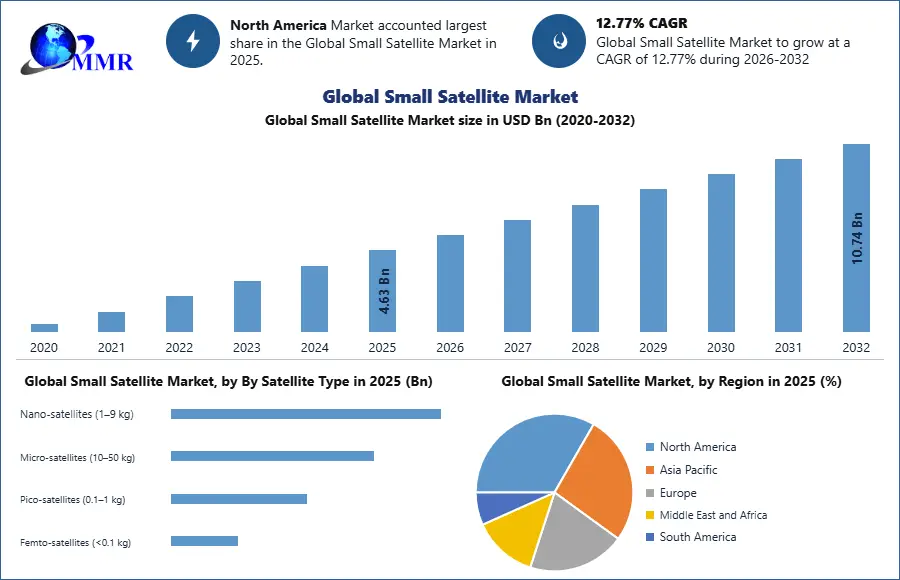
Global small satellite Market size was valued at USD 4.63 Billion in 2025
-
Expected to grow at a CAGR of 12.77 % from 2024 to 2032, reaching nearly USD 10.74 Billion.
-
IoT connectivity and broadband constellations are expanding the commercial use of small satellites.
-
Governments and defense agencies are increasing investments in surveillance, secure communications, and national space capabilities.
-
Asia-Pacific is emerging as a key growth region as India, China, Japan, and South Korea strengthen their space programs.
Why This Matters Now
The space economy is moving from a government-led domain to a commercial infrastructure market. Small satellites are at the center of that transition because they offer faster deployment, lower mission costs, and scalable constellation models.
For telecom operators, Earth observation providers, and defense agencies, the shift is strategic. Satellite networks are becoming part of broader digital infrastructure, supporting connectivity, remote sensing, logistics tracking, and national security operations.
Market Overview
The Small Satellite Market size is expanding as miniaturization, lower launch costs, and growing demand for satellite-enabled services reshape the global space industry. Small satellites, including nanosatellites, microsatellites, and CubeSats, are increasingly used for Earth observation, communication, navigation, scientific research, and defense applications.
The market is benefiting from a structural shift in launch economics. Reusable launch vehicles, rideshare missions, and dedicated small-launch providers have reduced the cost of placing satellites into orbit, making commercial deployments more viable for startups, telecom operators, and research institutions.
Earth observation remains a major driver. Governments and private companies are using satellite imagery for agriculture, climate monitoring, disaster management, urban planning, and environmental analysis. The ability to deploy constellations of small satellites provides more frequent data collection and broader geographic coverage.
Connectivity demand is another major catalyst. Telecom operators and satellite communication companies are investing in low Earth orbit constellations to support broadband access, IoT connectivity, and remote-area communications. This is particularly important in regions where terrestrial network infrastructure is limited or costly to build.
Key Trends Driving Growth
The market is being shaped by a combination of technological, commercial, and geopolitical trends. Miniaturized electronics, advanced sensors, and improved onboard processing capabilities are making small satellites more capable and cost-effective.
The rise of satellite constellations is a defining trend. Instead of relying on a few large satellites, operators are deploying fleets of smaller satellites to provide continuous coverage, redundancy, and faster data refresh rates. This model is particularly important for broadband services, Earth observation, and IoT applications.
Private investment is accelerating innovation. Venture capital, government contracts, and public-private partnerships are supporting the development of launch services, satellite manufacturing, data analytics, and downstream applications. The ecosystem is becoming more competitive as startups challenge established aerospace and telecom companies.
Defense and security applications are also expanding. Governments are using small satellites for surveillance, reconnaissance, secure communications, and space situational awareness. The ability to deploy satellites quickly and at lower cost makes them valuable for national security strategies.
Segment Insights
-
Dominant Segment: Earth observation applications remain a leading demand driver because governments, agriculture companies, and environmental agencies require frequent, high-resolution satellite data.
-
Fastest-Growing Segment: Communication satellites are expanding rapidly as broadband constellations and IoT connectivity projects increase deployment activity.
-
Satellite Type: Nanosatellites and CubeSats are gaining traction due to their lower manufacturing costs and suitability for constellation-based missions.
-
Application: Defense, commercial communications, remote sensing, scientific research, and navigation services are major end-use areas.
-
End User: Government agencies, defense organizations, telecom operators, research institutions, and private space companies are key customers.
Regional Growth Story
North America remains a leading market due to strong commercial space activity, advanced satellite manufacturing capabilities, and significant defense investment. The United States continues to be a major hub for launch providers, satellite operators, and space technology startups.
Europe is also an important market, supported by Earth observation programs, climate monitoring initiatives, and collaboration through regional space agencies. European companies are focusing on satellite data services, telecommunications, and sustainable space operations.
Asia-Pacific is emerging as a high-growth region. India, China, Japan, and South Korea are investing heavily in launch infrastructure, satellite manufacturing, and national space programs. India, in particular, is gaining attention for cost-effective launch services and a growing private space ecosystem.
Emerging economies are also creating demand for small satellites. Governments are using satellite technology to improve disaster management, agricultural monitoring, border security, and connectivity in remote areas.
Competitive Landscape
The competitive landscape includes established aerospace companies, satellite manufacturers, launch service providers, and emerging space startups. Competition is intensifying around launch capacity, constellation deployment, satellite miniaturization, and downstream data services.
Major players are investing in vertically integrated capabilities, including satellite manufacturing, launch services, ground stations, and data analytics. This integration helps companies capture more value across the satellite ecosystem and improve service reliability.
Partnerships are becoming a key strategy. Telecom operators, cloud providers, and satellite companies are collaborating to integrate satellite connectivity with terrestrial networks, enabling hybrid communication solutions for enterprise and consumer applications.
Innovation is also focused on reducing satellite size while improving performance. Advances in propulsion, power systems, sensors, and onboard computing are allowing small satellites to handle more complex missions that were previously reserved for larger spacecraft.
Recent Developments
-
Satellite operators are expanding low Earth orbit constellations to support broadband internet and IoT connectivity.
-
Launch providers are increasing rideshare missions, making orbital access more affordable for small satellite companies.
-
Governments are funding Earth observation and defense satellite programs to strengthen national space capabilities.
-
Private companies are investing in satellite data analytics platforms for agriculture, climate monitoring, logistics, and urban planning.
-
Advances in miniaturized sensors and onboard processing are improving the capabilities of nanosatellites and CubeSats.
Strategic Implications
For telecom operators, small satellites represent an opportunity to extend coverage, support rural connectivity, and integrate satellite links with 5G and future network architectures. Hybrid terrestrial-satellite networks could become a key competitive advantage in underserved regions.
For governments and defense agencies, the market offers faster deployment cycles and more resilient space-based capabilities. Small satellite constellations can provide redundancy, rapid replacement, and broader coverage for surveillance and communication missions.
For investors, the market is attractive because it spans manufacturing, launch services, data analytics, and connectivity applications. Companies that can combine satellite hardware with high-value data services are likely to capture the strongest long-term opportunities.
Future Outlook
The Small Satellite Market is expected to remain one of the most dynamic segments of the global space industry. Demand for Earth observation, broadband connectivity, IoT services, and defense applications will continue to drive satellite deployments.
The next phase of growth will depend on constellation scalability, launch reliability, spectrum management, and the ability to monetize satellite data services. Companies that can integrate satellite infrastructure with digital platforms and analytics capabilities will be best positioned to lead the market.
The decisive inflection point is clear: organizations that build scalable satellite constellations and convert orbital data into commercial services will define the next generation of the space economy, while slower competitors risk losing relevance in a rapidly commercializing market.
Analyst Perspective
About Maximize Market Research
Maximize Market Research Pvt. Ltd. (MMR) is a global market research and consulting firm known for delivering accurate, actionable, and data-driven insights. Our expertise spans diverse industries — including medical devices, pharmaceuticals, technology, automotive, electronics, chemicals, personal care, and consumer goods. We provide services such as market-validated forecasts, competitive intelligence, strategic consulting, and industry impact analysis, helping businesses navigate market complexities and achieve sustainable growth.
2nd Floor, Navale IT Park Phase 3
Pune Banglore Highway, Narhe
Pune, Maharashtra 411041, India
+91 9607365656
sales@maximizemarketresearch.com





Leave a Reply