
Key Highlights
-
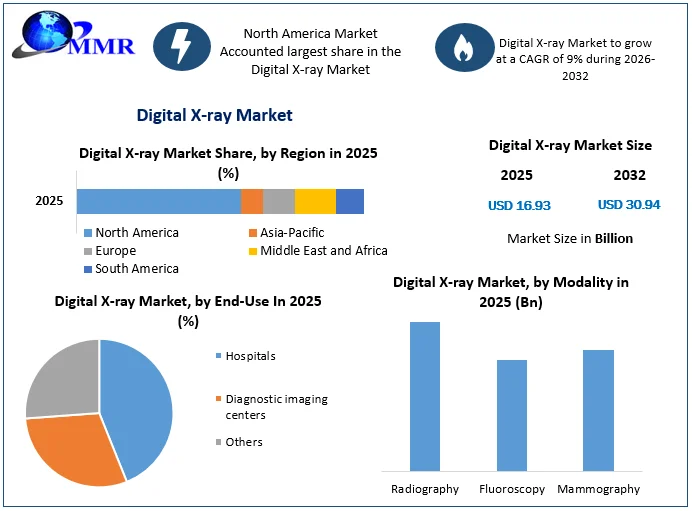
Market Valuation: Valued at USD 16.93 billion in 2025, capital allocation across health systems will propel the global market to USD 30.94 billion by 2032.
-
Compounded Growth: Fleet modernization and workflow digitisation generate a sustained 9% CAGR throughout the 2026–2032 forecast window.
-
Technology Transition: Computed Radiography secured a 54.6% market share in 2025 due to low initial costs, but rapid clinical workflows favor Digital Radiography retrofits.
-
Modality Dominance: General radiography represents the primary clinical entry point, capturing more than 48.5% of overall market revenue in 2025.
-
AI Integration: Major medical equipment manufacturers are embedding machine learning algorithms to automate positioning, speed throughput, and catch critical triage cases early.
Why This Matters Now
Operating margins across global hospital networks are under intense pressure from expanding patient volumes and tightening third-party payer reimbursements. Legacy film and classic phosphor-cassette systems create operational bottlenecks that slow diagnosis and limit daily outpatient capacity.
Transitioning to high-efficiency digital systems allows immediate image interpretation, dramatically elevating patient screening capacity without expanding physical clinic footprints. Minimizing image processing times from minutes to seconds fundamentally alters the economics of diagnostic departments, transforming imaging from a sluggish cost center into a high-throughput asset.
Market Overview
The global digital X-ray market represents a structural shift away from analog, chemical-dependent film and phosphor-based plates toward direct solid-state digital detection. Modern architectures rely on lightweight, compact flat panel detectors or charge-coupled devices to capture and transmit high-contrast radiographs instantaneously. By removing chemical development steps and physical cassettes, healthcare institutions decrease the total cost per individual image while reducing diagnostic processing latency.
According to data compiled by Maximize Market Research, the global market reached a valuation of USD 16.93 billion in 2025. Driven by steady institutional adoption and regular technology replacement cycles, total revenue will expand at a 9% CAGR to achieve a projected market size of USD 30.94 billion by 2032. This financial growth tracks an ongoing clinical push toward diagnostic precision, workplace safety, and institutional cost compression.
Key Trends Driving Growth
Escalating disease prevalence combined with a rapidly aging global population creates an expanding pool of patients requiring primary diagnostic screenings. Chronic conditions require clear, high-definition visualization to inform downstream orthopedic, pulmonology, and oncological treatment pathways. Because x-ray examinations serve as the near-universal baseline for clinical pathways, growing patient volumes force networks to deploy faster, automated imaging modalities.
Simultaneously, the integration of artificial intelligence into software suites addresses acute radiologist shortages and processing delays. AI algorithms operate directly on mobile and stationary units to assist with complex clinical applications, such as real-time image stitching or immediate critical care notifications. Furthermore, these solid-state detection systems require significantly lower ionizing radiation doses than traditional film architectures, matching stringent institutional safety protocols and patient-centric value care frameworks.
𝐃𝐨𝐰𝐧𝐥𝐨𝐚𝐝 𝐏𝐃𝐅 𝐁𝐫𝐨𝐜𝐡𝐮𝐫𝐞 @ https://www.maximizemarketresearch.com/request-sample/65053/
Segment Insights
-
Radiography (Dominant Modality): Accounting for more than 48.5% of total revenue in 2025, radiography remains the dominant segment. Because general radiography is the mandatory first diagnostic step for the vast majority of medical conditions, high baseline utilization ensures steady system sales.
-
Mammography (High-Growth Modality): Driven by an expanding global breast cancer burden—which reached approximately 2,261,420 new cases and caused 684,998 deaths in 2020—mammography adoption is accelerating rapidly as public screening mandates expand.
-
Computed Radiography (Dominant Technology): Holding a 54.6% revenue share in 2025, Computed Radiography (CR) dominates current global installations. CR represents the primary digital upgrade path for mid-tier institutions because its cassette-based Phosphor Storage Plates offer a cheaper entry point than full system replacements.
-
Digital Radiography (Fastest-Growing Technology): Utilizing direct flat panel detectors, Digital Radiography (DR) is the fastest-growing technology segment. Hospitals choose DR upgrades because they provide superior contrast resolution, lower radiation exposure, and instant image viewing to optimize clinical workflows.
-
Stationary Systems (Dominant Mobility): Fixed, stationary installations commanded 68.0% of total revenue in 2025, anchoring high-volume radiology departments that require heavy-duty, multi-application configurations.
-
Mobile Systems (Fastest-Growing Mobility): Mobile and portable systems are expanding at the fastest rate across the mobility segment, capturing market share via rapid deployment in intensive care units, operating rooms, and emergency departments.
Regional Growth Story
North America commands the leading position in the global digital X-ray market, backed by intensive capital expenditure from mature hospital groups and favorable commercial reimbursement structures. The region’s advanced infrastructure supports the immediate integration of high-cost digital radiography setups and novel AI diagnostics. Close collaboration between research institutions and medical device companies accelerates local product validation and commercial deployment.
Europe ranks as the second-largest market, with regional researchers actively filing the highest number of diagnostic imaging patents globally. European health systems focus heavily on safety, driving replacement cycles toward low-radiation flat panel setups. Meanwhile, Asia-Pacific represents a crucial expansion frontier for manufacturers; nations like China, India, and South Korea face soaring diagnostic demands due to massive populations and expanding hospital construction. While budget restrictions in developing Asian economies historically sustained computed radiography systems, public modernization initiatives are opening major avenues for direct digital radiography adoption.
Competitive Landscape
The global arena is highly consolidated, with top-tier medical engineering corporations leveraging targeted product development and regulatory clearances to protect operating margins. Market leaders focus on shifting product portfolios from raw hardware assembly toward integrated, software-driven diagnostic ecosystems. Success requires continuous research spending to deliver systems that offer higher imaging resolution at reduced physical weights and power requirements.
To counter the growing threat of low-cost, refurbished medical systems in developing territories, major players use a multi-pronged approach. They combine premium, high-margin product launches with flexible financing and tiered technology retrofits designed for mid-sized community clinics. By providing clear pathways to upgrade existing analog or CR systems using advanced flat panel detectors, global manufacturers secure long-term software licensing and maintenance agreements.
Recent Developments
-
Regulatory Clearance: In March 2021, Koninklijke Philips N.V. obtained US Food and Drug Administration 510(k) clearance for the CombiDiagnost R90, combining remote-controlled fluoroscopy with high-end digital radiography.
-
Mobile Innovation: GE Healthcare launched the AMX Navigate in September 2021, expanding its portable digital radiography footprint to streamline bed-side clinical workflows.
-
Embedded Software: Siemens Healthineers introduced the Ysio X.pree X-ray platform featuring native artificial intelligence to automate complex image acquisition steps.
-
Specialized Analytics: Siemens Healthineers deployed its Mammovista B.smart software platform to materially accelerate reading times for multi-modality breast tissue imaging.
-
Strategic AI Alliance: Canon Medical Systems partnered with Zebra Medical Vision to offer automated machine learning analytics packages directly to clinical operators across the United States.
Strategic Implications
The current wave of regulatory clearances and product debuts demonstrates that hardware performance alone no longer guarantees market leadership. The inclusion of remote-controlled features and embedded software indicates that manufacturers are positioning software as a primary differentiator to capture customer loyalty. Hospital networks purchasing new equipment prioritize platforms that reduce manual alignment steps, directly lowering staff burnout and minimizing repeating scans.
Furthermore, strategic alliances between hardware giants and artificial intelligence startups signal a shift toward algorithmic diagnostic triage. Systems that automatically flags critical conditions like pneumothorax or misplaced lines give hospitals a strong mechanism to mitigate clinical risk. For investors and developers, capital will increasingly flow to modular digital radiography solutions that allow older imaging machinery to receive high-performance software updates seamlessly.
Future Outlook
Looking toward 2032, the digital X-ray landscape will witness a steady decline in standalone computed radiography systems as flat panel detector costs drop and production lines scale up. Value-based care reimbursement structures will penalize slow, low-throughput infrastructure, making the total cost of ownership for direct digital systems highly competitive. The long-term future belongs to fully unified, cloud-connected imaging platforms capable of streaming raw data directly into predictive health networks. The market will ultimately separate forward-thinking leaders who invest heavily in integrated, AI-driven digital workflows from lagging operators tied to disconnected, manual imaging systems.
Analyst Perspective
“The structural transition from legacy computed radiography to direct digital radiography is no longer a luxury choice for premier healthcare systems; it is an absolute operational necessity to preserve operating margins. By removing manual cassette handling and leveraging machine learning at the point of capture, modern digital platforms turn basic diagnostic imaging into an efficient, high-speed automated workflow.” — Komal Patil, Research Analyst, Maximize Market Research
About Maximize Market Research
Maximize Market Research Pvt. Ltd. (MMR) is a global market research and consulting company that provides reliable, data-focused, and practical business insights. The firm serves a wide range of industries, including healthcare, pharmaceuticals, technology, automotive, electronics, chemicals, personal care, and consumer goods. Through market forecasts, competitive analysis, strategic consulting, and industry impact assessments, MMR helps organizations understand changing market conditions, identify growth opportunities, and make informed business decisions for long-term success.
2nd Floor, Navale IT Park Phase 3
Pune Banglore Highway, Narhe
Pune, Maharashtra 411041, India
+91 9607365656
sales@maximizemarketresearch.com





Leave a Reply