
Key Highlights
-
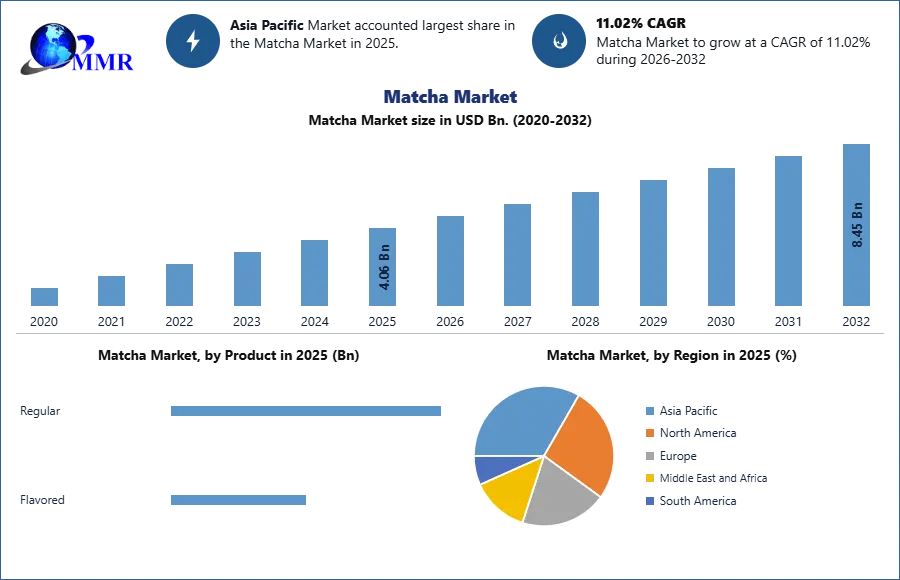
Valuation Surge: The global matcha market size achieved a baseline valuation of USD 4.06 Billion in 2025 and is projected to reach USD 8.45 Billion by 2032.
-
Compounded Growth: Total industrial revenue is expanding at an estimated Compound Annual Growth Rate (CAGR) of 11.02% over the 2026–2032 forecast horizon.
-
Core Catalyst: Strong health positioning backed by high antioxidant concentration, clean energy attributes, and balanced nutrition profile is accelerating category expansion.
-
Application Diversification: The ingredient is transitioning from traditional tea usage into mainstream bakery, confectionery, dairy, ready-to-drink (RTD) lines, and nutraceutical applications.
-
Geographic Evolution: The Asia-Pacific region maintains production and volume leadership, while North America and Europe emerge as high-margin growth hubs driven by wellness-oriented consumer demand.
Why This Matters Now
Coffee brands, beverage companies, and consumer packaged goods (CPG) manufacturers are fighting a high-stakes war for market relevance as consumer preferences shift heavily toward functional health. Legacy beverage architectures are rapidly losing volume share to clean-energy alternatives that combine premium experiential value with functional nutrition. The global matcha market size was valued at USD 4.06 Billion in 2025 and is projected to scale to USD 8.45 Billion by 2032, expanding at an 11.02% CAGR. This rapid growth indicates that functional ingredients are no longer just niche items for specialty health channels; they are reshaping mainstream portfolio strategies for global food and beverage firms.
For commercial executives, ignoring the matcha category is no longer an option. Consumers are actively ditching high-sugar energy options and synthetic ingredients for natural formulations that offer a clean, sustained energy boost. Brands that fail to integrate matcha into their ready-to-drink portfolios, bakery formulations, or functional wellness lines within the next 24 months risk losing core shelf placement to agile competitors.
Market Overview
The financial dynamics of the global matcha market Size reveal a resilient sector shifting from premium agricultural crop to scalable industrial raw material. Operating at an 11.02% CAGR between 2026 and 2032, the volume of matcha moving through global shipping lanes and retail supply lines is scaling rapidly. This expansion is supported by highly organized e-commerce logistics and digital commerce models that bypass traditional retail bottlenecks.
This growth reflects a fundamental shift in how modern consumers judge product value. Exceptional taste profile alone is no longer enough to support premium retail pricing; consumers demand clean sourcing and clear wellness benefits. Matcha satisfies these expectations, giving CPG manufacturers a reliable way to boost margin profiles across multiple product categories. From powdered mixes to functional energy shots, the crop provides an efficient ingredient framework for entering the premium health and wellness sector.
Key Trends Driving Growth
-
Functional Beverage Reshaping: Mainstream beverage developers are replacing traditional caffeine sources with matcha to fulfill consumer demand for steady, crash-free energy drinks.
-
Clean-Label Product Transition: Food processors are using minimally processed matcha powder to avoid synthetic colorants and artificial flavor additives.
-
Premiumization Valuation Lift: Specialty café operators and restaurant networks are commanding higher average ticket sizes by offering premium matcha lattes and specialty beverages.
-
Digital Commerce Penetration: E-commerce direct-to-consumer infrastructure allows boutique producers to scale globally without needing massive physical distribution footprints.
𝐃𝐨𝐰𝐧𝐥𝐨𝐚𝐝 𝐏𝐃𝐅 𝐁𝐫𝐨𝐜𝐡𝐮𝐫𝐞 @ https://www.maximizemarketresearch.com/request-sample/27981/
Segment Insights
-
Regular Matcha [Dominant Segment]: This product tier holds the largest volume share of the global market. Its dominance is driven by high ingredient demand across mass-market beverage manufacturing, industrial food production, and standard retail packaging.
-
Organic Matcha [Fastest-Growing Segment]: This segment is expanding at the fastest growth rate in the industry. The surge is driven by strict clean-label standards and growing consumer willingness to pay a premium for verified sustainable farming practices.
-
Beverages [Dominant Application Segment]: The beverage sector remains the primary application channel for the industry. Growth is driven by rapid expansion across premium café chains, specialized tea retailers, and ready-to-drink product rollouts.
-
Functional Foods & Nutraceuticals [Emerging Opportunity Segment]: The integration of matcha powder into dietary supplements, health bars, and wellness tablets represents a high-margin growth opportunity for brand developers.
Regional Growth Story
The Asia-Pacific region continues to lead the global industry in both production volume and overall consumption. This ongoing dominance is sustained by deep cultural traditions, optimized agricultural supply chains, and strong consumer adoption across modernized beverage options. Additionally, established processing infrastructure across regional hubs ensures a steady supply of premium and food-grade raw materials for global export.
Concurrently, the North American market has become a major engine for high-margin revenue growth. This development is driven by health-conscious consumers adopting matcha-infused ready-to-drink options and natural energy lines as part of their daily wellness routines. In Europe, the clean-label trend is driving steady market penetration across specialty beverage bars and premium retail stores. Together, these regional trends demonstrate that the matcha market has successfully transitioned from a traditional regional specialty into a global consumer category.
Competitive Landscape
The corporate structure of the global matcha market is shifting from simple product availability to a focus on brand authenticity, verifiable sourcing, and manufacturing innovation. Scale-driven multinational firms are actively competing against boutique regional farms by implementing advanced production quality standards and expanding their organic ingredient portfolios. This competitive dynamic indicates that the sector is entering a phase of mature market concentration.
Over the next 12 to 24 months, these shifts predict a clear consolidation wave across international supply lines. Larger ingredient aggregators are likely to pursue strategic acquisitions or exclusive partnerships with traditional Japanese estates to secure high-quality supplies. For secondary brands and smaller competitors, this consolidation means that relying on open-market sourcing will become increasingly risky. To maintain stable manufacturing margins, mid-tier players must either lock in long-term supply agreements or shift their branding focus toward highly specialized functional applications.
Recent Developments
-
Corporate Ingredient Integration: Major multi-unit beverage chains expanded their seasonal menus into permanent matcha-based product lines. This move signals long-term corporate commitment to the functional category and creates predictable, year-round raw material volume demands.
-
Supercritical Processing Scaling: Processing facilities upgraded their machinery to include precise, low-temperature milling equipment designed to preserve active antioxidant profiles. This technical advancement helps suppliers command higher B2B ingredient premiums from pharmaceutical and cosmetics buyers.
-
Digitalized Supply Tracking: International importers implemented end-to-end blockchain tracing to verify geographic origin and organic certification levels. This digital transition helps protect supply chains from low-quality ingredient mixing and structural trade disruption.
Strategic Implications
Corporate procurement managers must address the supply risks of a highly centralized agricultural production footprint. Relying on spot-market transactions leaves companies vulnerable to price volatility caused by regional climate impacts or shipping delays. Procurement teams should build direct multi-year agreements with established supply aggregators to secure consistent pricing and quality tiers.
Product formulation teams should focus on expanding beyond standard hot beverage lines. Adding matcha flour and stable extracts to baked goods, dairy alternatives, and packaged snacks allows brands to command higher clean-label retail prices. Additionally, ready-to-drink beverage brands should invest in specialized packaging that protects active botanical ingredients from UV light breakdown, ensuring a longer retail shelf life.
Future Outlook
The coming years will separate market leaders who secure high-quality, traceable organic supply networks to dominate the premium functional market, from slow-moving traditional brands whose margins will face pressure from rising raw material costs and evolving consumer expectations.
Analyst Perspective
“The Matcha Market’s growth from USD 4.06 Billion in 2025 to USD 8.45 Billion by 2032 signals a major shift in how the global food and beverage industry approaches clean energy and functional formulations. Matcha has broken out of the specialty tea aisle to become a key ingredient across high-margin CPG portfolios. Companies that build transparent, secure supply relationships today will be best positioned to capture premium market share as global demand accelerates.” — Siddhi Dole, Research Analyst, Maximize Market Research
About Maximize Market Research
Maximize Market Research Pvt. Ltd. (MMR) is a global market research and consulting company that provides reliable, data-focused, and practical business insights. The firm serves a wide range of industries, including healthcare, pharmaceuticals, technology, automotive, electronics, chemicals, personal care, and consumer goods. Through market forecasts, competitive analysis, strategic consulting, and industry impact assessments, MMR helps organizations understand changing market conditions, identify growth opportunities, and make informed business decisions for long-term success.
2nd Floor, Navale IT Park Phase 3
Pune Banglore Highway, Narhe
Pune, Maharashtra 411041, India
+91 9607365656
sales@maximizemarketresearch.com





Leave a Reply