
Key Highlights
-
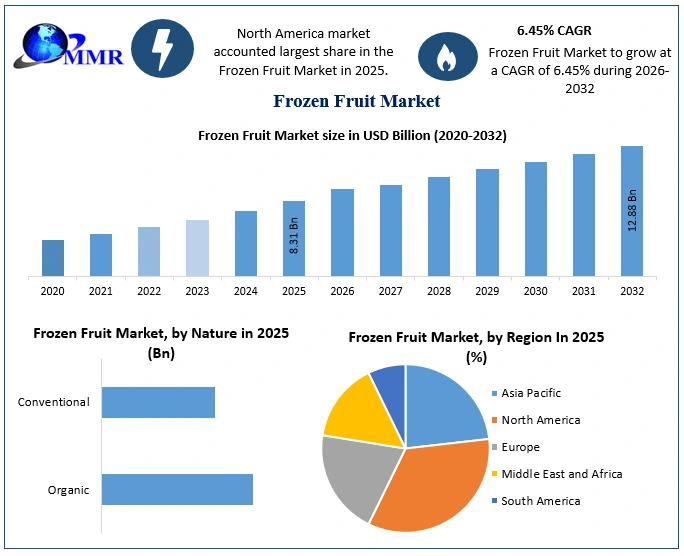
Market Scaling: The global frozen fruit market size achieved a valuation of USD 7.81 billion in 2024 and is projected to reach nearly USD 12.88 billion by 2032.
-
Compounded Momentum: The sector is advancing at a steady Compounded Annual Growth Rate (CAGR) of 6.45% during the 2025–2032 assessment window.
-
Form Dominance: Diced frozen fruits represent the largest product form segment, anchored by structural volume requirements across functional beverages, commercial bakeries, and industrial dairy lines.
-
Key Growth Drivers: Widespread consumer demand for healthy, ready-to-eat convenience options and functional breakfast solutions is compelling industrial food brands to increase their utilization of flash-frozen agricultural inputs.
-
Primary Constraints: Profit margins face constant pressure from rising operational costs—specifically labor, energy, and specialized cold chain transportation—alongside intense retail competition from fresh, canned, and dried fruit categories.
Why This Matters Now
Fast-moving consumer goods (FMCG) brands face structural margin erosion if they fail to adapt their processing pipelines to mitigate escalating labor and energy costs within the industrial cold chain. Corporate procurement directors can no longer treat flash-frozen agricultural commodities as static components; they are critical baseline tools to manage raw ingredient volatility and eliminate operational prep times in commercial kitchens. For boardroom executives and category managers, securing scalable volume contracts for pre-processed, high-stability frozen fruits is now a core operational priority to insulate retail pricing from seasonal crop failures and labor shortages.
Market Overview
The Frozen Fruit Market size corporate mechanics of the global frozen fruit market rely on flash-freezing technology to halt industrial degradation, locking in the baseline nutrient density, color profile, and structural integrity of fresh harvests. This processing method converts highly perishable agricultural assets into shelf-stable, format-flexible industrial inputs that food manufacturers utilize throughout the calendar year. Structurally, the commercial market processes whole, sliced, and diced fruit varieties to fulfill volume requirements across industrial beverage production, commercial bakeries, clinical dairy matrices, and retail direct-to-consumer breakfast lines.
Global distribution networks are handling significantly higher volumes as modern urbanization patterns and expanding middle-class demographics across emerging economies change daily calorie consumption. While fresh fruit remains a strong traditional competitor, its short ambient lifecycle introduces extensive waste management challenges and pricing instability for commercial food service operators. Consequently, industrial manufacturers are shifting bulk purchasing volumes toward the frozen sector to guarantee year-round menu uniformity, minimize ingredient preparation costs, and secure predictable operating margins across international supply networks.
Key Trends Driving Growth
The steady expansion of the global functional beverage and premium smoothie sector acts as the primary volume catalyst for frozen fruit processing lines. Busy modern lifestyles have permanently established quick-service smoothie chains, high-protein drink mixes, and functional yogurt bowls as global wellness staples. Because these product matrices require a thick, chilled consistency without excessive ice dilution, commercial food operators rely directly on frozen fruit pieces to act as both the core nutrient source and a structural cooling agent.
Concurrently, a strong trend toward health and wellness is driving consumer behavior shifts away from chemically preserved or high-sugar canned fruits. Modern grocery shoppers are actively scanning retail freezers for clean-label, individually quick-frozen (IQF) fruit options that list zero added sugars or synthetic texturizers. This cultural alignment allows manufacturers to position frozen fruit lines as nutritionally identical to fresh harvests, breaking down legacy consumer misconceptions regarding the freshness and quality of frozen agricultural goods.
The rapid implementation of data analytics and cold chain optimization models across major logistics networks is simultaneously unlocking new geographic distribution channels. Leading food processors are deploying advanced temperature tracking sensors and localized automated warehouse systems to minimize thermal exposure during cross-border transit. These technological investments drastically reduce product spoilage rates, enabling suppliers to reliably deliver premium, exotic fruit varieties from major agricultural hubs to high-density, dairy-deficient urban centers.
𝐃𝐨𝐰𝐧𝐥𝐨𝐚𝐝 𝐏𝐃𝐅 𝐁𝐫𝐨𝐜𝐡𝐮𝐫𝐞 @ https://www.maximizemarketresearch.com/request-sample/221569/
Segment Insights
-
Diced Frozen Fruits [Dominant Segment]: Capturing the largest structural market share, this form is highly favored by food manufacturers due to its multi-application versatility across commercial smoothies, desserts, industrial salads, and yogurt toppings.
-
Fruit Blends & Smoothie Packs [Fastest-Growing Segment]: Propelled by intensifying consumer demand for convenient, pre-portioned functional breakfast options, these innovative mixed-product lines represent the fastest-expanding retail category.
-
Convenience & Food Service [Dominant End Use]: Driven by intense commercial requirements from quick-service restaurants, industrial bakeries, and mass-market beverage packagers, this segment commands massive bulk procurement volumes.
-
Industrial Dairy and Bakery Applications: Functioning as a high-value revenue vector, this sector leverages stabilized frozen fruit pieces to maintain color consistency and structural uniformity in automated pastry and ice cream production lines.
Regional Growth Story
The industrial landscapes of North America and Europe continue to hold a massive consolidated share of the global frozen fruit market size. Growth across these mature economies is tied to exceptionally high per-capita consumption of premium baked goods, extensive household freezer penetration, and deep consumer purchasing power supporting high-ticket fitness supplements and functional organic foods. Furthermore, well-established frozen food retail distribution networks and massive commercial food service sectors ensure consistent volume movement for tier-one ingredient suppliers.
Concurrently, emerging markets across the Asia-Pacific region are positioned for rapid, strong expansion over the 2025–2032 forecast window. This regional acceleration is supported by expanding urban populations, rising middle-class household incomes, and a rapidly growing demographic of health-conscious consumers across major metropolitan hubs. As modern grocery store formats and specialized e-commerce cold chains expand across developing Asian territories, consumer purchasing is shifting toward premium, imported frozen fruit variants and high-convenience meal solutions.
Competitive Landscape
The global competitive arena is characterized by a mix of specialized agricultural processors and dominant food conglomerates operating international supply lines. Industry leaders—including Kendall Fresh Frozen Fruits, Inc., Del Monte Produce Inc., Nomad Foods, Nature’s Touch, HARVEST FOOD GROUP, Titan Frozen Fruit, Meel Corp., and Val-Mex Frozen Foods, LLC—are actively reallocating capital expenditure toward manufacturing technologies to differentiate their portfolios from basic agricultural commodities. Major food industry leader Nestle is also continuously focused on technological advancement and the development of new frozen fruit products to capture shifting retail wellness demands.
For small and medium-sized regional players operating in different countries, the competitive playground centers on technological development and new product launching in local markets. To protect operating margins against volatile raw crop prices and high logistics costs, forward-thinking manufacturers are deploying data analytics to gain valuable insights into localized consumer behavior and regional market trends. Companies unable to invest in these digital forecasting tools and cold chain optimization models risk being underbid by global giants utilizing scale to dominate bulk commercial procurement contracts.
Recent Developments
-
Cold Chain Optimization Rollouts: Major players like Nomad Foods are scaling up their deployment of consumer-centric innovation and cold chain optimization technologies, utilizing advanced data analytics to gain precise insights into localized market trends.
-
Technological Product Advancements: Nestlé has continuously directed capital reserves toward technological advancements and the development of new frozen fruit formulations, actively targeting high-growth functional beverage and wellness channels.
-
Formulation Packaging Solutions: Ingredient processors are refining packaging standards to address rising government regulations regarding processing waste, forcing a industry shift toward sustainable materials that maintain strict moisture barriers.
-
Regional Production Expansions: Mid-tier frozen food suppliers are executing local facility upgrades across emerging agricultural hubs, seeking to flash-freeze crops immediately at the source to maximize nutrient retention and reduce upstream transport waste.
Strategic Implications
The operational updates from recent quarters clarify that simple processing volume is no longer a sufficient economic moat; technological integration throughout the cold chain is the true determinant of market retention. Nomad Foods’ implementation of data analytics and cold chain optimization directly addresses the primary vulnerability in frozen ingredient logistics—thermal fluctuation during cross-docking. By utilizing predictive modeling to align shipping schedules with regional demand trends, the company minimizes warehouse dwell times, protecting product quality while shielding its bottom line from escalating energy grid costs.
Concurrently, the persistent market dominance of the diced form segment exposes a critical B2B reality: commercial food operators are willing to pay a premium to eliminate processing labor inside their own facilities. Diced frozen fruits eliminate the labor costs, knife-handling safety risks, and structural waste associated with peeling and cutting raw crops in high-volume commercial kitchens. Ingredient processors that can guarantee absolute uniformity in dicing dimensions are successfully embedding their products into the automated assembly lines of mass-market yogurt and bakery brands, establishing multi-year contract security.
Furthermore, tightening government regulations regarding packaging waste are turning environmental compliance into a critical entry barrier for mid-tier processors. As international regulators implement strict rules regarding the carbon footprint and plastic output of frozen food processing, traditional low-cost plastic film packaging is becoming an operational liability. Top-tier manufacturers that proactively invest in sustainable, high-barrier compostable or recyclable packaging solutions are securing early preference from major multinational retail buyers who mandate green supply chains to satisfy corporate ESG targets.
Future Outlook
The global frozen fruit market will continue to bifurcate based on logistics automation and raw material price insulation. Over the next 12 to 24 months, expects an acceleration in specialized product rollouts, specifically pre-portioned functional fruit blends and smoothie packs tailored for rapid automated retail distribution. Ultimate market victory belongs to agile ingredient processors who can successfully optimize their cold chain logistics to insulate operations from rising energy and labor costs, while corporate operators who fail to transition away from basic commodity packaging will face severe margin compression.
Analyst Perspective
“The global frozen fruit industry is moving away from its legacy identity as a basic agricultural commodity and entering a phase defined by logistical technology and format convenience. The sustained market dominance of diced forms and the rapid expansion of functional fruit blends demonstrate that modern food manufacturing clients demand pre-processed, high-stability ingredients that eliminate processing labor and waste. Success in this margin-sensitive sector requires absolute control over cold chain logistics, automated processing consistency, and continuous adaptation to evolving sustainable packaging mandates.”
— Siddhi Dole, Research Analyst, Maximize Market Research
About Maximize Market Research
Maximize Market Research Pvt. Ltd. (MMR) is a global market research and consulting company that provides reliable, data-focused, and practical business insights. The firm serves a wide range of industries, including healthcare, pharmaceuticals, technology, automotive, electronics, chemicals, personal care, and consumer goods. Through market forecasts, competitive analysis, strategic consulting, and industry impact assessments, MMR helps organizations understand changing market conditions, identify growth opportunities, and make informed business decisions for long-term success.
2nd Floor, Navale IT Park Phase 3
Pune Banglore Highway, Narhe
Pune, Maharashtra 411041, India
+91 9607365656
sales@maximizemarketresearch.com





Leave a Reply