
Key Highlights
-
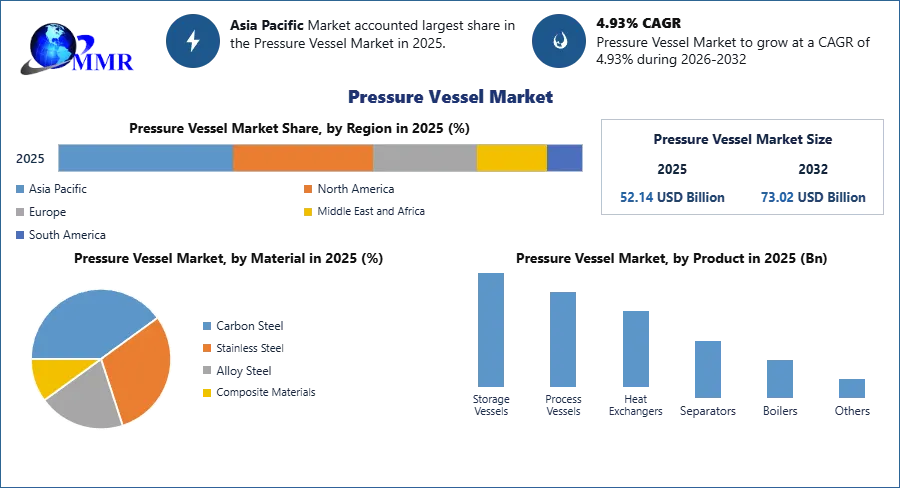
Market Valuation: Reached USD 52.14 Billion in 2025 and is projected to hit USD 73.02 Billion by 2032.
-
Growth Velocity: Expanding at a steady compound annual growth rate of 4.93% over the forecast period.
-
Technological Shift: Rapid migration from passive containment units to intelligent, sensor-driven assets connected to plant-wide Distributed Control Systems (DCS).
-
Regional Dominance: Rapid industrialization and power sector investments make the Asia-Pacific region the absolute frontrunner in volume and value.
-
Safety and Compliance: Stricter international safety codes and asset integrity regulations are accelerating the replacement of aging infrastructure with smart vessels.
Why This Matters Now
The convergence of escalating safety mandates and the urgent need for operational efficiency is forcing a radical redesign of traditional industrial processing infrastructure. Industrial operators can no longer afford unexpected downtime or catastrophic failures, making the transition to digitally monitored containment assets an absolute operational necessity.
Simultaneously, the global push toward clean energy and advanced chemical processing demands infrastructure capable of handling extreme pressures and temperatures while feeding real-time telemetry to centralized control rooms. This shift transforms pressure vessels from simple mechanical containers into critical nodes within the broader Industrial Internet of Things (IIoT) ecosystem.
Market Overview
The global Pressure Vessel Market is undergoing a structural realignment, expanding from its USD 52.14 Billion baseline in 2025 to an anticipated USD 73.02 Billion by 2032. This growth represents a 4.93% CAGR, driven primarily by the modernization of processing plants and the continuous expansion of the oil, gas, chemical, and nuclear power sectors.
What has changed fundamentally is the baseline expectation of asset performance; modern plants require continuous monitoring of internal conditions to maintain peak efficiency. Why this transformation is happening now stems from the falling cost of advanced industrial sensors and the widespread commercial deployment of edge computing platforms.
The primary beneficiaries of this shift are industrial technology buyers and operations executives who can now eliminate manual testing protocols in favor of automated, non-destructive continuous assessment. Moving forward, the market will see standard mechanical pressure vessels phased out entirely in favor of units built with integrated digital architectures designed for rapid deployment into existing supervisory networks.
Key Trends Driving Growth
The most profound trend shaping the market is the rapid deployment of digital twin technology across complex manufacturing ecosystems. By pairing physical pressure vessels with real-time digital replicas, operators can simulate stress patterns, thermal cycles, and corrosion rates without interrupting active production lines.
Furthermore, advancements in predictive maintenance algorithms allow facilities to move away from rigid, calendar-based maintenance shutdowns toward condition-based interventions. This shift directly optimizes operational expenditure by ensuring that maintenance teams only service vessels when sensor data indicates actual material fatigue or structural anomalies.
The proliferation of industrial cybersecurity initiatives also plays a crucial role in current growth patterns. As pressure vessels become increasingly integrated with Programmable Logic Controllers (PLCs) and Supervisory Control and Data Acquisition (SCADA) systems, protecting these nodes from external digital threats has become as critical as physical pressure relief systems. Consequently, manufacturers are embedding secure-by-design communications protocols directly into the electronic monitoring suites of next-generation vessels.
Get a free sample:https://www.maximizemarketresearch.com/request-sample/23071/
Segment Insights
-
Dominant Segment (Boiler & Reactor Vessels): Holding the largest market share, these vessels remain the foundational workhorses of the power generation and heavy chemical manufacturing sectors, where continuous-duty cycles dictate asset specifications.
-
Fastest-Growing Segment (Separators & Heat Exchangers): Driven by rapid investments in carbon capture utilization, hydrogen processing, and advanced refining techniques that require highly complex internal geometries and specialized multi-phase processing capabilities.
-
Material Segment (Steel Alloys): High-strength steel alloys dominate industrial procurement due to their proven thermal resistance, structural integrity under extreme load, and established welding compliance standards.
-
Application Segment (Chemical & Petrochemical): This sector commands the highest volume of vessel deployment, dictated by the global expansion of refining capacities and specialized polymer production facilities.
Regional Growth Story
The Asia-Pacific region stands as the absolute powerhouse of the pressure vessel market, driven by massive manufacturing investments in China, India, and South Korea. China continues to accelerate its smart manufacturing initiatives, embedding advanced automation directly into its heavy industrial hubs to counter shifting labor demographics and optimize resource usage. India’s aggressive expansion of its domestic refining and petrochemical capacities provides an expansive footprint for newly designed, high-capacity processing vessels.
In North America, particularly the United States, the market focus leans heavily toward factory modernization and infrastructure replacement. Aging processing plants are aggressively deploying capital to swap out legacy units with intelligent vessels equipped with advanced IIoT sensors to meet stringent EPA and OSHA compliance guidelines. Meanwhile, Germany leads Europe’s demand, focusing intensely on integrating hydrogen-compatible pressure vessels into its evolving green energy grid and automated process manufacturing sectors.
Competitive Landscape
The competitive arena is shifting away from pure metallurgical superiority toward software-enabled value differentiation. Traditional heavy fabricators are forming strategic partnerships with industrial automation giants, system integrators, and software developers to deliver turnkey processing nodes rather than simple steel shells. This realignment signals that future market leadership belongs to companies capable of offering comprehensive lifecycle asset management solutions.
Ecosystem positioning now dictates that a pressure vessel vendor must provide validated digital integration paths for major DCS and SCADA platforms. Companies that fail to offer open-architecture telemetry outputs are finding themselves excluded from major greenfield project tenders. The market is witnessing a clear dividing line between legacy mechanical fabricators and advanced industrial technology providers who treat metallurgy and software engineering as equal disciplines.
Recent Developments
-
DCS Native Integration: Leading manufacturers have begun shipping pressure vessels with pre-installed sensor arrays that automatically configure themselves upon connection to standard industrial Ethernet networks.
-
Advanced Robotics Inspection: Fabrication yards are utilizing automated robotic welding and machine vision systems to eliminate structural micro-defects during the initial assembly phases of high-pressure units.
-
AI-Driven Edge Diagnostics: Newly deployed separation vessels now feature edge-computing enclosures that run localized AI models to identify turbulent flow anomalies before they cause internal erosion.
-
Composite Material Testing: Increased field testing of advanced composite-wrapped steel vessels designed to offer higher weight-to-strength ratios for specialized clean energy transport applications.
Strategic Implications
For plant managers and manufacturing leaders, the evolution of the pressure vessel market demands an immediate reassessment of procurement and maintenance strategies. Investing in lower-cost, non-communicating legacy vessels introduces long-term operational liabilities, including higher inspection costs and an inability to participate in plant-wide digital optimization programs. Decision-makers must view pressure vessels as dynamic data sources that feed directly into the enterprise’s broader operational intelligence matrix.
System integrators must also upgrade their skillsets to accommodate the complex sensor payloads now arriving standard on modern processing equipment. The traditional separation between mechanical installation and control system programming has completely dissolved. Achieving maximum return on investment from these advanced assets requires seamless data loops that link physical pressure metrics directly to automated throughput throttling algorithms.
Future Outlook
The future of the pressure vessel market belongs to fully autonomous industrial operations where containment assets dynamically communicate their health status to automated plant ecosystems. We are rapidly approaching an inflection point where pressure vessels will self-diagnose structural wear, automatically schedule their own non-disruptive robotic inspections, and adjust localized process parameters via PLC networks to prevent accelerating material degradation. The definitive dividing line in industrial manufacturing will separate future automation leaders who leverage intelligent processing nodes for continuous uptime from laggards trapped in cycle-based maintenance loops that drain corporate profitability.
Analyst Perspective
“The global pressure vessel market is no longer a static sector defined solely by steel thickness and welding certifications. Today, it sits directly at the intersection of heavy metallurgy and advanced industrial automation, where the value of an asset is increasingly determined by its digital connectivity and ability to protect plant profitability through real-time telemetry.”
— Gaurav Deshmukh, Lead Analyst, Maximize Market Research
About Maximize Market Research
Maximize Market Research Pvt. Ltd. (MMR) is a global market research and consulting company that provides reliable, data-focused, and practical business insights. The firm serves a wide range of industries, including healthcare, pharmaceuticals, technology, automotive, electronics, chemicals, personal care, and consumer goods. Through market forecasts, competitive analysis, strategic consulting, and industry impact assessments, MMR helps organizations understand changing market conditions, identify growth opportunities, and make informed business decisions for long-term success.
2nd Floor, Navale IT Park Phase 3
Pune Banglore Highway, Narhe
Pune, Maharashtra 411041, India
+91 9607365656
sales@maximizemarketresearch.com




Leave a Reply