
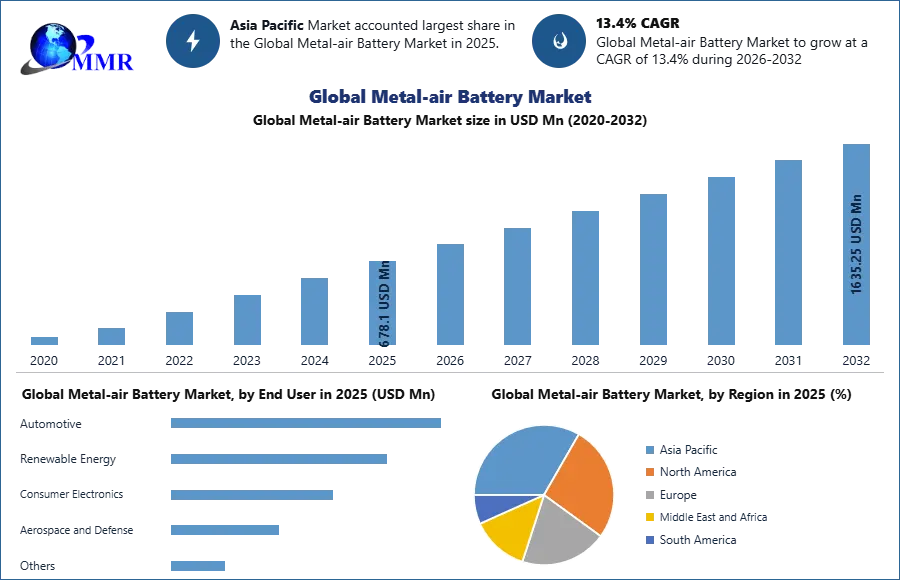
Market Overview
The Metal-Air Battery Market is evolving from a research-led segment into an increasingly important component of future energy systems. Rising investment in electric vehicles, renewable energy storage, and sustainable infrastructure is accelerating industry attention.
What changed is the scale of demand for long-duration, high-capacity energy storage. Electrification is expanding simultaneously across transportation, industrial operations, consumer technologies, and energy networks. Existing storage technologies remain critical, but manufacturers and technology developers are actively exploring alternatives capable of delivering higher performance and improved efficiency.
Metal-air batteries have attracted interest because they use oxygen from ambient air as a cathode reactant, enabling significantly higher theoretical energy density compared with many traditional battery systems. This characteristic positions the technology as a potential solution for industries facing growing power requirements and increasing pressure to reduce emissions.
For investors, the market represents exposure to one of the most closely watched segments in advanced energy storage. For OEMs, it represents an opportunity to improve product performance while addressing sustainability targets.
Key Trends Driving Growth
Transportation electrification remains one of the most influential growth drivers. Automakers continue pursuing technologies that can extend vehicle range, improve efficiency, and reduce overall system weight. Metal-air batteries have emerged as a technology of interest because higher energy density could support these objectives.
Renewable-energy expansion is creating a second major demand catalyst. Utilities and grid operators require storage technologies capable of balancing intermittent generation from solar and wind resources. As renewable penetration increases, demand for long-duration storage solutions continues to rise.
Sustainability requirements are also reshaping investment priorities. Governments, corporations, and infrastructure developers are increasingly focused on carbon reduction and energy efficiency. These objectives are encouraging exploration of battery technologies that can support cleaner energy ecosystems.
The electronics sector is becoming another important consideration. Smart devices, connected equipment, industrial sensors, and IoT deployments continue expanding globally. While many applications currently rely on established battery technologies, the search for longer operational lifecycles and greater energy efficiency is creating future opportunities for advanced battery systems.
Research activity remains intense across the industry. Developers are focusing on improving rechargeability, reducing performance degradation, and addressing commercialization challenges. Progress in these areas could accelerate broader adoption across transportation, industrial, and energy-storage applications.
Request a Free Sample Copy or View Report Summary: https://www.maximizemarketresearch.com/request-sample/189413/
Segment Insights
-
Dominant Segment: Zinc-Air Batteries
Zinc-air technology represents the leading segment within the metal-air battery landscape. Its relatively mature development profile, material availability, and suitability for multiple applications support its market position. -
Fastest-Growing Segment: Electric Vehicle Applications
Electric mobility continues to attract substantial attention as manufacturers seek next-generation energy-storage solutions capable of delivering longer operating range and enhanced efficiency. -
Application Opportunity: Renewable Energy Storage
Growing renewable-energy deployment is increasing demand for storage technologies capable of supporting grid stability and long-duration power availability. -
Technology Focus: Rechargeable Metal-Air Systems
Industry investment increasingly targets rechargeable designs that can unlock broader commercial deployment across transportation and industrial sectors.
Regional Growth Story
Asia-Pacific continues to play a central role in the evolution of the Metal-Air Battery Market. The region benefits from extensive electronics manufacturing ecosystems, strong battery production capabilities, and aggressive investment in clean-energy technologies.
China remains strategically important because of its scale across electric vehicle manufacturing, battery development, renewable-energy deployment, and industrial production. This combination creates favorable conditions for commercialization and technology development.
Japan and South Korea contribute through advanced materials expertise, battery innovation, and electronics leadership. Their established positions within global supply chains support continued investment in next-generation energy-storage technologies.
India is emerging as an increasingly relevant market due to electrification initiatives, manufacturing expansion, and government support for energy transition programs. As domestic electronics and mobility ecosystems grow, advanced battery technologies could gain additional strategic relevance.
North America and Europe are pursuing parallel objectives focused on energy security, supply-chain resilience, and clean-energy leadership. Investment in battery innovation is increasingly linked to broader goals surrounding industrial competitiveness and technology sovereignty.
The competitive race is therefore becoming global. Regions capable of combining research leadership, manufacturing capacity, and commercialization expertise will hold significant advantages.
Competitive Landscape
Competition in the Metal-Air Battery Market is defined by technological execution rather than manufacturing scale alone. Companies are competing to solve challenges related to rechargeability, cycle life, efficiency, and commercial viability.
The most important signal emerging from the competitive environment is the growing alignment between battery innovation and broader industrial strategy. Energy storage is becoming a critical enabling technology for transportation, digital infrastructure, renewable-energy systems, and industrial automation.
Research partnerships, material science investments, and pilot-scale commercialization efforts indicate that market participants are positioning for future adoption rather than short-term volume gains. Companies capable of translating laboratory breakthroughs into scalable production will gain meaningful competitive advantages.
The market is also attracting attention because advanced battery technologies increasingly influence supply-chain decisions. Energy-storage performance can affect vehicle design, infrastructure economics, and industrial productivity. As a result, technology leadership is becoming a source of pricing power and ecosystem influence.
Recent Developments
-
Increased research activity focused on improving rechargeable metal-air battery performance.
-
Growing interest in electric vehicle applications requiring higher energy-density storage solutions.
-
Expansion of renewable-energy projects driving demand for long-duration storage technologies.
-
Rising investment in sustainable energy systems and carbon-reduction initiatives.
-
Continued innovation in materials and battery chemistry aimed at improving commercial viability.
Strategic Implications
For semiconductor manufacturers, advanced batteries represent an important complement to future computing infrastructure. AI systems, edge devices, industrial automation platforms, and connected ecosystems all require increasingly sophisticated power-management strategies.
For electronics OEMs, metal-air batteries offer a potential pathway toward longer operating lifecycles and improved energy efficiency. For investors, the technology represents participation in one of the industry’s most closely monitored innovation areas.
Supply chains are also evolving. Companies are seeking diversified sourcing strategies, stronger sustainability credentials, and technologies capable of supporting future energy requirements. These priorities are creating new opportunities for battery developers, material suppliers, and technology providers.
Future Outlook
The future of the Metal-Air Battery Market will depend on the industry’s ability to convert promising energy-density advantages into commercially scalable, reliable, and rechargeable products. Success would reshape transportation, renewable energy storage, industrial systems, and next-generation electronics.
The decisive competitive divide will not be between companies that manufacture batteries and those that do not—it will be between organizations that master advanced energy-storage architectures for the AI-powered economy and those that remain constrained by legacy power technologies.
Analyst Perspective
“Metal-air batteries are attracting increasing strategic attention because they address one of the most important challenges facing electrification and advanced digital infrastructure: delivering more energy with greater efficiency. The organizations that successfully commercialize these technologies could influence the next generation of transportation, energy storage, and electronics innovation.” — Rucha Deshpande, Analyst
About Maximize Market Research
Maximize Market Research Pvt. Ltd. (MMR) is a global market research and consulting company that provides reliable, data-focused, and practical business insights. The firm serves a wide range of industries, including healthcare, pharmaceuticals, technology, automotive, electronics, chemicals, personal care, and consumer goods. Through market forecasts, competitive analysis, strategic consulting, and industry impact assessments, MMR helps organizations understand changing market conditions, identify growth opportunities, and make informed business decisions for long-term success.
2nd Floor, Navale IT Park Phase 3
Pune Banglore Highway, Narhe
Pune, Maharashtra 411041, India
+91 9607365656
sales@maximizemarketresearch.com







Leave a Reply