
Key Highlights
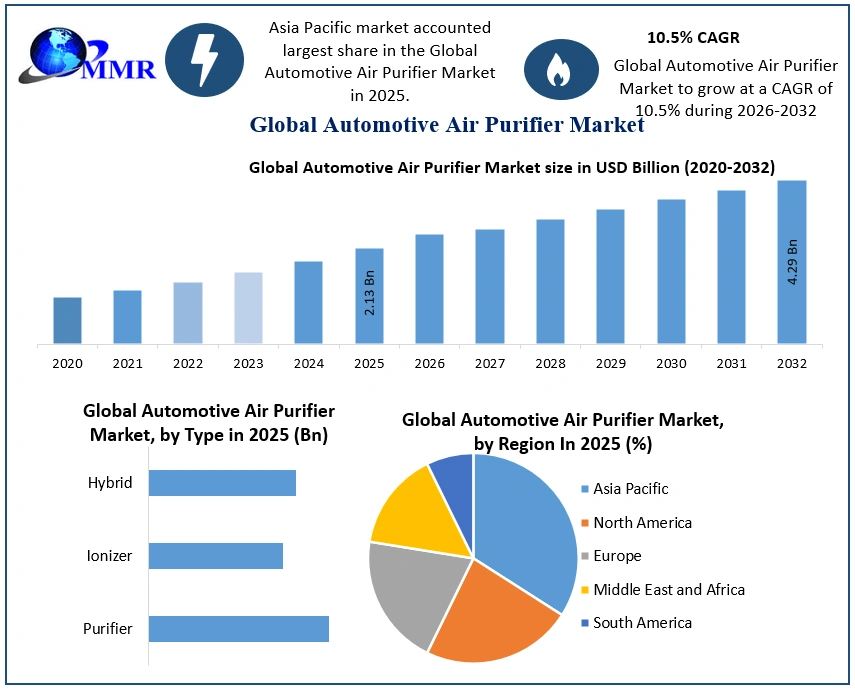
- Automotive Air Purifier Market valued at USD 2.13 billion in 2025.
- Market projected to reach USD 4.29 billion by 2032.
- Expected CAGR of 10.5% during 2026–2032.
- Growing consumer concern over air pollution is accelerating adoption.
- OEMs increasingly position cabin-air quality as a premium vehicle feature.
- EV manufacturers are integrating advanced purification technologies into connected vehicle ecosystems.
- Asia-Pacific remains a critical growth center due to urbanization and vehicle ownership expansion.
- Aftermarket demand continues to create recurring revenue opportunities for filtration suppliers.
Why This Matters Now
Air quality has moved from a public-health issue to a vehicle purchasing criterion. Automakers that once competed on horsepower and infotainment are now competing on passenger wellness.
The Automotive Air Purifier Market is entering a growth phase as consumers demand cleaner cabin environments, regulators tighten environmental standards, and automakers seek new differentiation strategies. The market, valued at USD 2.13 billion in 2025, is expected to reach nearly USD 4.29 billion by 2032, expanding at a CAGR of 10.5%.
For OEMs, suppliers, investors, and mobility strategists, this is no longer a niche accessory category. It is becoming part of the broader transformation toward health-focused mobility.
Market Overview
Automotive air purifiers are designed to remove particulate matter, allergens, harmful gases, odors, and airborne contaminants from vehicle cabins. Their importance has increased alongside worsening urban pollution levels and growing consumer awareness of respiratory health.
The industry’s growth trajectory coincides with several structural shifts in the automotive sector. Electrification is changing vehicle architecture. Connected technologies are enabling real-time cabin monitoring. Consumers increasingly expect vehicles to function as protected personal environments rather than simple transportation assets.
As a result, air purification systems are moving from optional accessories toward integrated vehicle features. This transition is creating new opportunities for filtration specialists, HVAC suppliers, and OEMs seeking higher-value product differentiation.
Key Trends Driving Growth
The strongest growth catalyst remains rising concern over air pollution exposure. Consumers in major urban centers increasingly spend extended periods commuting through congested environments, creating demand for cleaner cabin air.
Advanced filtration technologies are becoming mainstream. HEPA-based systems continue to gain adoption due to their ability to capture fine particulate matter and allergens. Multi-stage filtration solutions combining HEPA, activated carbon, and ionization technologies are also expanding their market presence.
Electrification is creating another growth avenue. EV manufacturers increasingly promote cabin wellness features as part of premium ownership experiences. Battery-electric vehicles provide additional flexibility for integrating sophisticated air-management systems and connected monitoring capabilities.
Connectivity is further transforming the segment. Smart purification systems capable of monitoring cabin air quality and automatically adjusting filtration performance are moving from luxury segments into broader vehicle categories.
The aftermarket remains highly active. Vehicle owners are upgrading existing vehicles with portable and integrated purification systems, creating recurring demand beyond new vehicle production cycles.
Get a free sample now:https://www.maximizemarketresearch.com/request-sample/13992/
Segment Insights
- Dominant Segment: Passenger Cars
- Passenger vehicles account for the largest share of automotive air purifier demand due to higher vehicle volumes and increasing consumer focus on in-cabin health and comfort. Urban commuters represent a significant customer base for these solutions.
- Dominant Technology Segment: HEPA Filtration
- HEPA filtration remains the leading technology due to its effectiveness in capturing fine particulate matter and allergens. Growing awareness of air-quality risks continues to support adoption.
- Fastest-Growing Product Category: Hybrid Air Purifiers
- Hybrid systems combining multiple purification technologies are gaining traction because they address both particulate and gaseous pollutants while delivering broader performance benefits.
- Key Sales Channel Opportunity: Aftermarket
- The aftermarket continues to generate strong demand as consumers retrofit existing vehicles with purification technologies. Broad vehicle compatibility and lower upgrade costs support this channel.
- Emerging Opportunity: EV Applications
- Electric vehicles are expected to become a significant growth contributor as manufacturers increasingly integrate wellness-oriented features into next-generation vehicle platforms.
Regional Growth Story
Asia-Pacific remains one of the most important growth markets for automotive air purification technologies. Rapid urbanization, worsening air quality concerns, expanding middle-class populations, and increasing vehicle ownership continue to support demand across major economies including China, India, Japan, and South Korea.
China remains a strategic market due to high urban pollution levels and strong EV production capacity. Automakers operating in the country increasingly position air-quality technologies as premium value-added features.
India is emerging as a particularly attractive growth market. Rising consumer awareness, dense urban environments, and increasing adoption of connected vehicle technologies are creating favorable conditions for market expansion.
Europe continues to benefit from stringent environmental regulations and growing consumer preference for health-oriented vehicle technologies. Regulatory attention on cabin air quality is accelerating OEM investments in advanced filtration systems.
North America remains a stable market where premium vehicle adoption, consumer health awareness, and technological innovation support continued demand growth.
Competitive Landscape
Competition is increasingly shifting from standalone product performance toward integrated mobility solutions.
OEMs are evaluating air purification technologies as part of broader vehicle wellness ecosystems that combine HVAC systems, sensor networks, connected services, and intelligent climate control. This strategic positioning creates opportunities for suppliers capable of delivering integrated solutions rather than individual components.
Technology leadership increasingly depends on filtration efficiency, system integration, energy consumption, sensor accuracy, and software capabilities. Suppliers that combine these competencies are likely to gain stronger pricing power and deeper OEM relationships.
The market is also experiencing growing competition between factory-installed systems and aftermarket providers. While OEM integration improves user experience and vehicle value, aftermarket suppliers continue benefiting from the vast global vehicle parc.
Recent Developments
- Increasing integration of HEPA-based filtration systems into passenger vehicles.
- Expansion of hybrid purification technologies combining multiple filtration methods.
- Growing adoption of smart air-quality monitoring and automated purification controls.
- Rising OEM focus on health, wellness, and passenger comfort as competitive differentiators.
- Increased deployment of advanced purification systems in EV platforms.
- Regulatory developments supporting improved cabin-air quality standards in major automotive markets.
Strategic Implications
For OEMs, air purification is becoming part of brand positioning. Companies capable of translating health and wellness benefits into measurable customer value will strengthen differentiation in increasingly crowded vehicle segments.
For Tier-1 suppliers, the opportunity extends beyond filtration hardware. Sensor integration, software analytics, predictive maintenance, and connected services offer additional revenue streams.
For investors, the market sits at the intersection of automotive technology, environmental health, and connected mobility. These overlapping trends create a favorable long-term demand environment.
Fleet operators also stand to benefit. Cleaner cabin environments can improve passenger experience, support premium service positioning, and align with broader sustainability objectives.
Future Outlook
As vehicles become smarter, cleaner, and more personalized, in-cabin air quality will increasingly be viewed as a core vehicle performance metric rather than an optional feature. The companies that integrate purification technology into broader mobility and wellness ecosystems will define the next phase of competitive advantage, while laggards risk becoming commodity suppliers.
Analyst Perspective
“The Automotive Air Purifier Market is transitioning from an accessory-driven segment to a strategic automotive technology category. Growth will be driven by rising health awareness, increasing EV adoption, smarter vehicle architectures, and OEM efforts to differentiate through passenger wellness experiences.” — Tejaswini Kakade, Analyst
About Maximize Market Research
Maximize Market Research Pvt. Ltd. (MMR) is a global market research and consulting company that provides reliable, data-focused, and practical business insights. The firm serves a wide range of industries, including healthcare, pharmaceuticals, technology, automotive, electronics, chemicals, personal care, and consumer goods. Through market forecasts, competitive analysis, strategic consulting, and industry impact assessments, MMR helps organizations understand changing market conditions, identify growth opportunities, and make informed business decisions for long-term success.
Contact Us:
2nd Floor, Navale IT Park Phase 3
Pune Banglore Highway, Narhe
Pune, Maharashtra 411041, India
+91 9607365656
sales@maximizemarketresearch.com







Leave a Reply